AI Phone Answering vs. Traditional Answering Services for Auto Repair Shops
I have the data I need. The search results confirm the voicemail abandonment stats and I have enough seasonal data to work with. Let me write the article now.
According to Forbes, 80% of callers sent to voicemail don’t leave a message — they simply hang up and move on. For auto repair shops, the Automotive Service Association estimates each missed call represents roughly $650 in lost repair order revenue. Multiply that by a week of after-hours calls and the math gets uncomfortable fast.
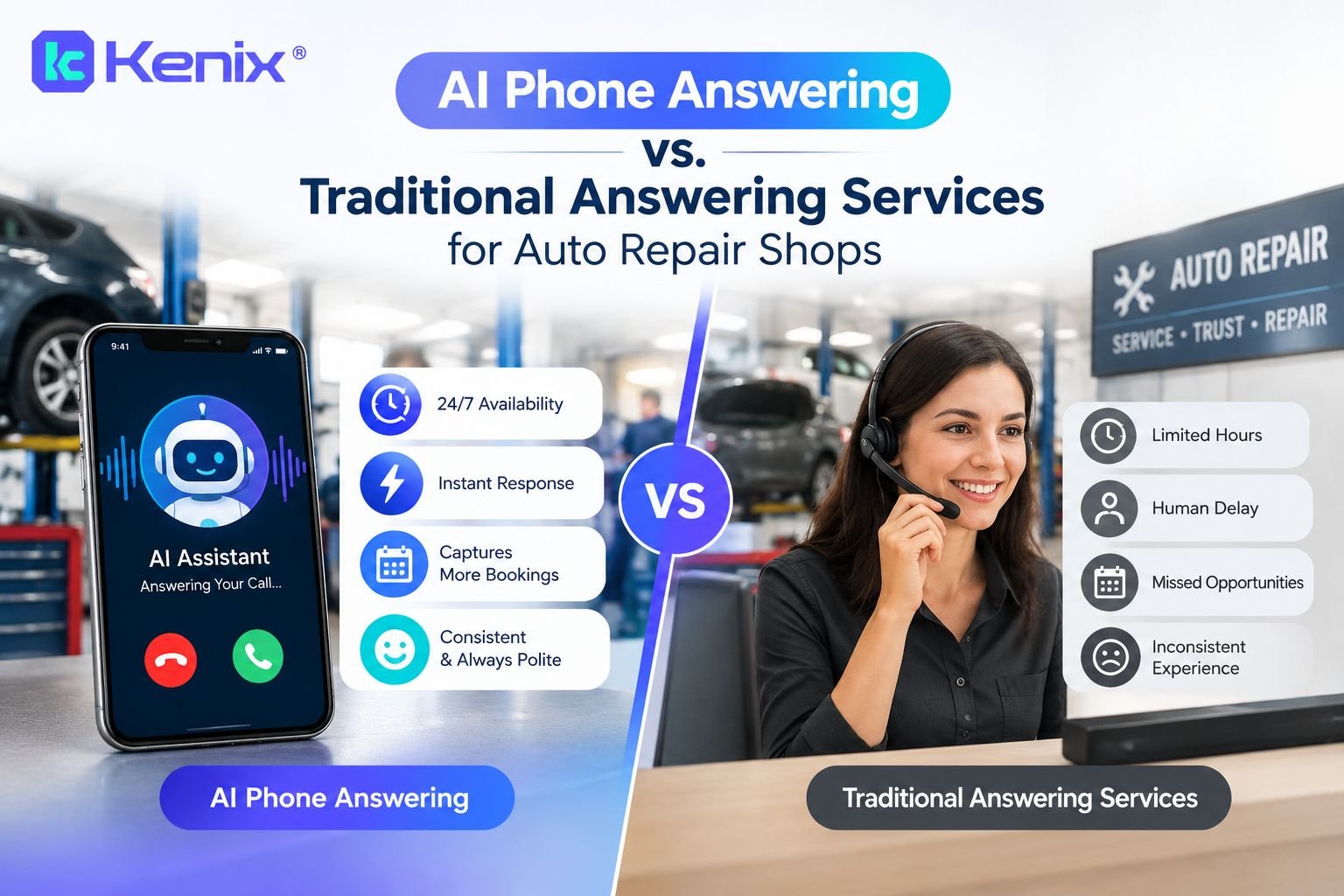
This article breaks down the three options shops are actually weighing in 2026 — human answering services, IVR phone menus, and AI-driven platforms — across every dimension that matters: availability, booking capability, cost, technical depth, and how each holds up when call volume spikes.
The Three Options Auto Repair Shops Are Actually Comparing
Most comparison articles pit AI against human answering services and leave it there. But a significant number of independent shops are still running something older: the basic IVR phone tree. Press 1 for appointments, press 2 for service status, press 3 to be ignored. That third option deserves a seat at the table, because it’s the default many shops quietly inherited from their VoIP provider and never replaced.
Here’s how the three options stack up at a high level:
Human answering services: Live call center operators who follow a script, take a name and number, and relay a message via email or portal. Priced at $1.00–$2.50 per minute, with night and weekend surcharges, averaging $150–$400+ per month for a moderate-volume shop.
IVR / basic phone menus: No intelligence, no booking capability. Routes frustrated callers to voicemail. Still common in independent shops running older phone systems.
AI-driven platforms (e.g., Kenix): Conversational AI that answers instantly, captures structured vehicle data, books directly to the calendar, and feeds every interaction into a connected CRM — starting from $499/month as a full-platform solution versus $1,000+ per month cobbling together five separate tools.
Availability and Response Speed: 24/7 vs. Business Hours
Human answering services operate on a sliding scale of commitment. Standard coverage typically means business hours; after-hours and weekend coverage costs extra — often 1.5–2× the base per-minute rate. Most small shops either absorb that premium or go dark after 5 PM. Neither is a good outcome in a market where a competitor is one Google search away.
IVR menus are technically available around the clock, but available isn’t the same as useful. When 80% of callers refuse to leave a voicemail, an IVR that dead-ends in voicemail isn’t “always on” — it’s always losing business.
AI systems answer on the first ring, in under one second, every call — nights, weekends, holidays — at no additional per-minute charge. Kenix goes further by triggering an automated, personalized follow-up within 60 seconds of any missed call, recovering opportunities that would otherwise walk straight to a competitor.
Consider the real scenario: a customer’s check engine light comes on at 9 PM Friday before a long weekend road trip. With a human service, a message waits until Monday morning. With an IVR, they hit voicemail and hang up. With an AI platform, they have a confirmed appointment before they’ve even thought about searching Google for another shop.
Booking Appointments vs. Taking a Message
This is the most consequential functional difference between the three options, and it’s not close.
Human answering services relay a message for a callback. That callback might happen an hour later, or the next morning — by which point the customer has already booked elsewhere. There is no direct calendar access, no confirmation text, no closed loop. The job the service “captured” is often already lost.
IVR menus cannot book at all. They can route to voicemail or ring an unanswered desk phone. That’s the full extent of their capability.
AI platforms integrate directly with the shop’s scheduling system and book during the call itself — checking bay availability, matching service type (oil change vs. brake job vs. multi-point diagnostic) to the right time slot, and sending a confirmation before the caller hangs up. Kenix data shows shops achieve 2.3× more bookings versus their pre-AI baseline, and its calendar system includes a live waitlist that automatically fills cancellations — something no human answering service offers.
The real-world impact is documented. After switching to an AI phone system, Jiffy Lube Central California reported a 5× increase in customer appointments, according to data cited by customer experience platform Convin.
Handling Industry-Specific Questions: Parts, Estimates, and Service Types
A human operator at a general answering service is not an automotive technician. They’re trained on a generic intake script: get a name, get a number, write “brake question,” move on. They cannot tell a caller whether you stock OEM brake pads for a 2021 F-150, offer a reasonable estimate range for a timing belt replacement on a high-mileage Camry, or distinguish a wheel alignment from a tire balance in any meaningful way.
The intake quality difference between a human operator and a well-trained AI is significant. A human operator writes “grinding noise.” A properly trained AI captures “2019 Honda Accord, 67,000 miles, grinding on front-left only during braking, brake warning light illuminated” — and your service advisor starts forming a diagnosis before the car pulls into the bay.
Kenix’s AI is trained on automotive terminology and can communicate your standard service price ranges, capture full vehicle intake including VIN, mileage, warning lights, and symptom descriptions, and flag whether a described issue sounds urgent or routine before routing appropriately. Its AI Analysis layer also scores calls for missed revenue opportunities — flagging deferred services and unapproved estimates that can be followed up automatically, even on calls a human advisor does take.
IVR menus, for completeness, provide zero answers to any technical question. A caller asking about a timing belt gets a menu prompt.
Cost Comparison: What You’re Actually Paying Per Month
The monthly cost comparison looks like this across all three options:
| Option | Typical Monthly Cost | What You Get |
| IVR / Basic Phone Tree | “Free” (bundled with VoIP) | Call routing only — no answers, no bookings |
| Human Answering Service | $150–$400+/month | Message relay, business hours; night/weekend premiums extra |
| Dedicated Receptionist | $4,300–$5,400/month ($52K–$65K/year incl. benefits) | Full coverage, high overhead, single point of failure |
| AI Platform (market entry) | From ~$109/month | AI answering only |
| Kenix (full platform) | From $499/month | VoIP + CRM + AI Call Analysis + Calendar + Reputation Management |
The IVR appears free on the surface. Its real cost is invisible — it lives in the calls it loses, not in the monthly line item. One small shop documented by Convin cut its phone costs from $400 to $50 per month (an 87.5% reduction) after switching to AI, while simultaneously increasing the calls it actually converted.
The ROI math is straightforward. At $650 per missed repair order, recovering just two additional calls per week generates roughly $5,200 per month in recovered revenue — a multiple of any platform’s monthly fee. Learn more about how Kenix calculates call recovery ROI to see the numbers for your specific call volume.
Kenix also offers a free pilot of up to one month with no credit card required, with KPI targets agreed in advance. Shops pay only when results are delivered.
Scalability During Seasonal Surges
This is the dimension competitors consistently ignore, and for shops that experience it, it can be the deciding factor.
Auto repair shops face two predictable demand spikes every year: AC system checks from May through July, and pre-holiday travel inspections in November and December. These aren’t minor bumps — call volume during peak periods can jump 30–50% within days as weather shifts or holiday travel dates approach.
Human answering services scale linearly with volume. More calls means more operator minutes billed, which means higher costs — often during the exact weeks when margin pressure is already tightest. Wait times also lengthen during these spikes, since call center capacity is shared across multiple clients. An already-stretched operation gets stretched further at the worst possible moment.
IVR menus handle unlimited concurrent calls without any quality degradation. The problem is they convert zero of them. A volume spike with an IVR just means more frustrated callers hitting dead ends simultaneously.
AI platforms handle unlimited simultaneous inbound calls with zero degradation in response time, no per-minute surcharges during surge periods, and no capacity limits. During an AC season rush, a shop running Kenix can simultaneously manage an inbound surge through the AI while the CRM layer runs targeted outreach to lapsed customers due for their seasonal service — a coordinated campaign that a human answering service and an IVR simply cannot execute.
See how Kenix manages seasonal call surges for auto repair shops without changes to your staffing or monthly budget.
The Verdict: Which Option Fits Which Shop
Human answering services make sense for shops with very low call volume — fewer than five calls per day — where per-minute costs stay below $50/month and inbound calls are primarily complex complaints or insurance disputes that genuinely require human empathy. They are not suited for routine booking calls.
IVR phone trees fit essentially no shop in 2026. If your shop is still running a basic phone menu, it is actively losing the majority of callers who won’t leave voicemail — and has been doing so quietly for years. This is a cautionary note, not a recommendation.
AI platforms fit any shop taking 10 or more calls per day, open to after-hours bookings, or exposed to seasonal volume spikes. Kenix specifically fits shops that want the entire revenue loop closed — from first ring through CRM follow-up, appointment confirmation, and review request — rather than a standalone phone tool. With a 94% call recovery rate, 2.3× booking lift, and a free pilot that requires no upfront commitment, the switching risk is as low as it gets.
Start Kenix’s free pilot for your shop and set KPI targets before you spend a dollar.
Frequently Asked Questions
Can an AI answering service handle emergency breakdown calls?
Yes. AI systems detect urgency cues in real time — overheating, brake failure, stalling, or similar language — and immediately route an alert via SMS to on-call staff. The caller gets a near-instant acknowledgment rather than a voicemail prompt, which is critical when someone is stranded.
What happens when a customer needs to speak with a human?
AI handles roughly 85% of routine calls without any escalation. Complex warranty disputes, insurance claims, or genuinely upset customers are routed via warm transfer or urgent callback scheduling. The AI doesn’t try to resolve what it shouldn’t — it knows when to hand off.
How does an AI platform book appointments without knowing my bay schedule?
It integrates directly with your shop management system — platforms like Tekmetric, Mitchell 1, and ShopWare are common integrations. Kenix uses its own capacity-aware calendar system, which accounts for bay availability and service duration so the AI never double-books or overcommits.
Will customers know they’re talking to AI?
AI systems introduce themselves professionally. In practice, customers consistently rate fast, accurate service over who answered — and an instant response with no hold time performs significantly better in satisfaction surveys than being placed on hold waiting for a human operator. Transparency and speed tend to work in the same direction.
How much does switching from a traditional answering service to AI actually save?
Results vary, but the documented range is substantial. One shop reduced monthly phone costs from $400 to $50 — an 87.5% reduction — after switching to AI according to Convin case data. Frame that against the $650-per-missed-call recovery math and the savings compound quickly on both sides of the ledger.
Conclusion
For any shop losing calls after hours, during peak bay periods, or during seasonal surges, the comparison across these three options points in one direction: AI delivers faster response, direct booking, industry-aware intake, and a lower total monthly cost than a human answering service — without the dead-end problem that makes IVR menus a liability disguised as infrastructure.
The only remaining question is execution risk, and Kenix eliminates that with a free pilot, agreed KPIs, and no credit card required. If the numbers don’t perform, you don’t pay. That’s a straightforward offer for a straightforward decision.
Back to the previous article