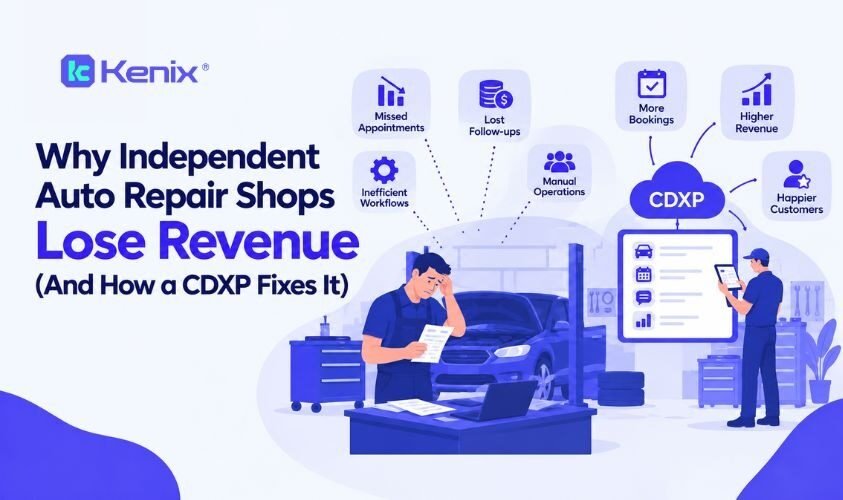
Why Independent Auto Repair Shops Lose Revenue (And How a CDXP Fixes It)
Objective
Our goal is to show you where auto repair revenue loss happens, why these small gaps can affect shop profit, and how a CDXP platform can help your team manage follow-up and revenue recovery more consistently.
Key Takeaways
- Auto repair revenue loss can start with missed calls, unbooked leads, no-shows, declined estimates, and inactive customers.
- Call volume alone does not show how much revenue your shop captures.
- A profit leak becomes more important when the same issue happens every week.
- A CDXP can bring customer data and follow-up workflows into one process.
- Your first step should be measuring where your biggest revenue gap occurs.
Introduction
Your shop can have plenty of customers and still lose revenue.
The reason is simple: not every customer opportunity becomes a completed repair. A call can be missed. An inquiry can go unanswered. An appointment can become a no-show. A customer can decline recommended work and never hear from your team again. Even a happy customer may not return if there is no follow-up.
These are not always large losses on their own. The real financial drain comes when the same gaps happen repeatedly.
That is why we should look beyond call volume and ask a better question: How much revenue does your shop actually capture from the opportunities it receives?
The U.S. Bureau of Labor Statistics reports that automotive service technicians and mechanics held about 805,600 jobs in 2024, with about 70,000 openings projected each year from 2024 to 2034. This does not prove that staffing limits cause revenue loss, but it shows why using available shop capacity efficiently matters.
In this guide, we’ll break down five common revenue leaks and show where a CDXP can support a more consistent recovery process.
Table of Contents
- The Revenue Leak Map
- Five Critical Revenue Leak Points
- Why Small Leaks Become a Bigger Financial Drain
- How a CDXP Helps Recover Revenue
- A Simple Revenue Recovery Framework
- FAQs
The Revenue Leak Map
Instead of measuring only how many calls you receive, track what happens after each opportunity enters your shop.
Call → Appointment → Arrival → Estimate → Authorization → Repair → Review → Return Visit
Every stage has a measurable outcome.
For example, if your call volume is high but appointment conversion is low, the problem may not be lead generation. Your leak may be happening between the call and the booking. If customers receive estimates but few approve additional work, your attention should move toward follow-up and authorization rate.
This simple model helps you find the exact stage where your revenue gap begins.
5 Critical Revenue Leak Points
1. Missed Calls
A missed call may be a customer who is ready to ask about a repair or schedule service. If nobody follows up, you may never know whether that caller would have become a repair order.
A missed call recovery process can give your team a way to respond when a call cannot be answered.
2. Unbooked Leads
Not every inquiry becomes an appointment. Someone may ask about availability, pricing, or a specific repair and then stop responding.
Track inquiries against booked appointments instead of looking at call volume alone. If 100 people contact your shop and only a portion book, that difference deserves attention.
3. No-Shows
A no-show can leave an appointment slot unused and affect technician productivity.
Simple confirmation and reminder workflows can help your team reduce preventable scheduling gaps and keep customers informed.
4. Declined Estimates
A declined estimate does not always mean the customer is permanently lost. The repair may not be urgent, the customer may need more time, or cost may affect the decision.
The Federal Trade Commission advises consumers to request written estimates and notes that estimates should state that the shop will seek approval before exceeding a specified amount where state law requires it.
That makes follow-up important. Your team can track authorization rate and create a clear process for customers who do not approve recommended work immediately.
5. Silent Happy Customers
A satisfied customer can create value beyond today’s repair order.
If you do not ask for a review, send appropriate service reminders, or maintain useful follow-up, you may miss future visits and opportunities to build your shop’s reputation.
Why Small Leaks Become a Bigger Financial Drain
One missed call is not the story. Repeated missed opportunities are.
Consider a shop that receives 500 calls in a month. Some calls may be missed, some callers may not book, some appointments may not show, and some recommended repairs may not be approved.
The point is not to assume every missed opportunity equals lost revenue. The point is to measure what happens at each stage and identify where customers are dropping out.
That is the profit leak worth fixing first.
How a CDXP Helps Recover Revenue
A Customer Data Experience Platform (CDXP) brings customer information and communication workflows together so your team can act on opportunities more consistently.
Kenix positions its offering as a CDXP for auto repair shops, with its positioning centered on helping repair businesses manage customer engagement and performance.
The practical idea is simple:
| Revenue leak | Recovery focus |
| Missed calls | Missed call recovery |
| Unbooked leads | Consistent follow-up |
| No-shows | Appointment reminders |
| Declined estimates | Re-engagement |
| Inactive customers | Service reminders |
| Happy customers | Review recovery |
This is not about automating every conversation. It is about giving your team a repeatable process for opportunities that are easy to miss during a busy day.
Build Your Revenue Recovery Framework
Start with four numbers:
- Monthly inquiries and calls
- Appointment conversion
- Authorization rate
- Returning customer
Then ask:
Where is the largest drop?
If calls are strong but bookings are weak, work on lead follow-up. If estimates are common but approvals are low, review your estimate communication and follow-up process. Fix one shop profit leak, measure the result, and then move to the next.
The Bottom Line: Find the Revenue You Already Earned the Chance to Win
Why auto shops lose money is not always a question of getting more customers. Sometimes the answer is that existing opportunities are not being followed through.
Review your calls, appointments, estimates, customer returns, and reviews. Once you know where the gap sits, a CDXP platform can help create a more consistent revenue recovery auto shop process.
Ready to Find Your Biggest Revenue Leak?
Review your shop’s missed calls, unbooked leads, declined work, and customer follow-up. Then see how Kenix can support a more measurable customer revenue process.
FAQs
Why do independent auto repair shops lose revenue?
Common sources include missed calls, unbooked inquiries, no-shows, declined work without follow-up, and customers who do not return.
How can an auto repair shop recover missed revenue?
Start by measuring each stage from inquiry to completed repair and focus first on the stage with the largest drop.
What is a CDXP for an auto repair shop?
A CDXP is a customer data and engagement platform designed to help businesses organize customer information and manage communication and follow-up workflows.
What should an auto repair shop measure besides call volume?
Track appointment conversion, show rate, authorization rate, completed repair orders, returning customers, and review activity.
Can missed calls affect auto repair revenue?
Yes. A missed call can represent a missed service opportunity, although the actual revenue impact depends on the type of call and whether the customer contacts the shop again.
Back to the previous article