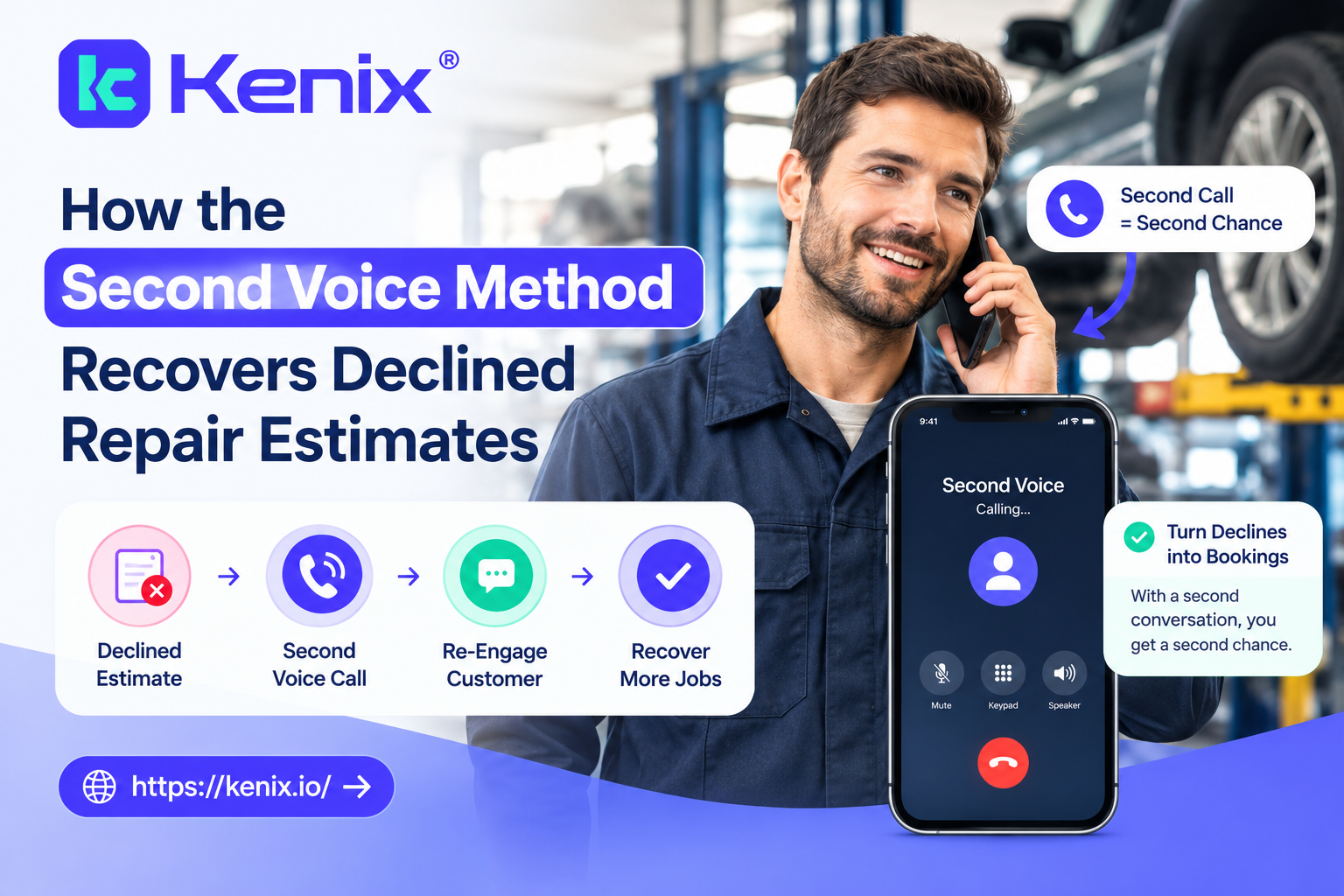
How the Second Voice Method Recovers Declined Repair Estimates
Key Takeaways
- Second voice recovery allows declined customers to control the conversation.
- Addressing the customer’s actual concerns requires looking beyond the repair estimate.
- To find the next best opportunity, call on the customer yourself.
- Offer choices to relieve customer anxiety, and consider the customer’s needs when doing so.
- Track callbacks and recovered work in your CRM pipeline.
- Use AI call intelligence to identify common objections and improve follow-up.
Introduction
A declined repair estimate is not always a lost customer. Sometimes the customer needs a clearer explanation, more time, or a different way to approach the repair.
That is where second voice recovery in auto repair can help. A manager callback gives the customer another opportunity to ask questions without simply repeating the original sales conversation.
For shop owners and service managers, the goal is simple: recover legitimate repair opportunities while keeping the conversation helpful, transparent, and customer-led.
Table of Contents
- What Is the Second Voice Method in Auto Repair?
- Why a Manager Callback on Declined Work Converts
- Which Declined Estimates Need a Second Voice Call?
- The 5-Step Manager Callback Script
- Handling Objections on a Declined Repair Callback
- Log and Measure Callbacks
- 5 Second Voice Mistakes to Avoid
- Example: One Callback, One Recovered Estimate
- How Second Voice Recovery Supports Authorization Rate Optimization
- Free Second Voice Recovery Playbook
- Frequently Asked Questions
- Conclusion
What Is the Second Voice Method in Auto Repair?
Second voice recovery is a structured follow-up where a manager or experienced team member contacts a customer after recommended repair work has been declined or deferred.
The manager reviews the original estimate, identifies the likely concern, answers questions, and determines whether there is a reasonable next step.
This is different from repeatedly asking, “Are you ready to approve the estimate?”
The first advisor presents the repair. The second voice call tries to understand why the customer did not move forward.
Kenix places approval recovery within its broader revenue recovery platform, which is designed to identify unapproved estimates and follow up on pending customer decisions.
Second Voice vs. Ordinary Follow-Up
| Ordinary follow-up | Second voice recovery |
| Checks whether the customer decided | Understands why they haven’t decided |
| Often automated | Usually manager-led |
| May repeat the estimate | Adds clarification and context |
| Focuses on the transaction | Focuses on the customer’s concern |
| Can feel generic | Can be personalized |
The distinction matters because manager intervention should add value, not create more pressure.
Why a Manager Callback on Declined Work Converts
A customer may decline an estimate for reasons that aren’t obvious from the repair order.
They may be concerned about price, unsure whether the repair is urgent, comparing another quote, or simply overwhelmed by several recommendations.
A manager callback on declined work creates another conversation where those concerns can surface.
A useful way to think about it is:
First voice: “Here is what your vehicle needs.”
Second voice: “What would help you make a decision?”
That shift can make the follow-up feel more like customer service than a sales call.
The broader industry is also moving toward structured follow-up rather than letting declined work disappear. Some current repair-focused workflows keep declined items connected to the vehicle and create a clear next action for the customer.
Why Manager Involvement Helps
A manager may be able to:
- Explain the recommendation differently
- Review the inspection evidence
- Clarify priorities
- Address unresolved concerns
- Discuss legitimate scheduling or payment options
- Coordinate a future appointment
The manager should not override the technician’s diagnosis or invent urgency. The purpose is clarity and trust-building, not pressure.
Which Declined Estimates Need a Second Voice Call?
Not every declined estimate needs the same level of follow-up.
Prioritize a declined repair callback when:
- The estimate has significant value.
- The customer said they may return later.
- The customer asked questions that weren’t fully answered.
- Price was the main objection.
- The recommendation has a meaningful maintenance or safety consideration.
- The customer has an established relationship with the shop.
Lower-priority opportunities can often receive an SMS or email instead.
Call vs. Text vs. Email
Phone: Best for high-value opportunities and complex objections.
SMS: Great for short reminders, links, and scheduling.
Email: Useful if the customer needs detailed information or documentation about the estimate.
The channel should follow the customer’s preference whenever possible.
The 5-Step Manager Callback Script
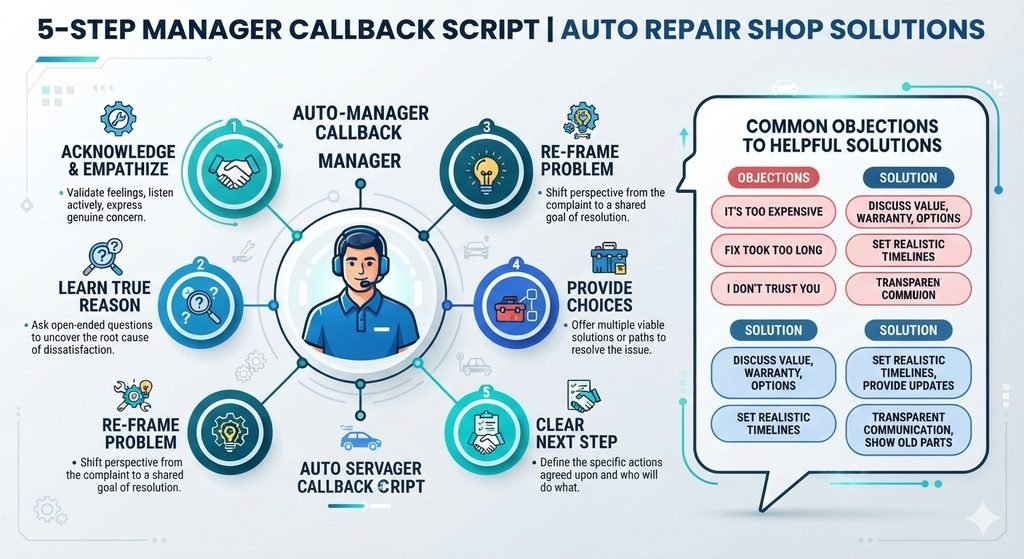
A repeatable script keeps the estimate recovery call consistent without making every conversation sound robotic.
1. Acknowledge & Empathize
Start by demonstrating that you understand the last interaction.
Hi Sarah, this is Mike, the service manager. I recall we discussed the brake repair on your last visit. “I just wanted to touch base and see if you had any questions about the recommendation.”
Not by asking permission first.
2. Learn The True Reason
Ask the open question:
“Was there anything in the estimate or recommendation that made you want to hold off?”
Hear before you speak.
This could be:
Price
Mistake about Time
Distrust
Need a second opinion
Plans for vehicle ownership
3. Re-framing the problem
Describe the recommendation based on the information already recorded in the shop.
“Do the repair that addresses the customer’s original concern and tell the customer what the technician found.
Don’t create urgency by increasing risk.
4. Provide choices
Discuss legitimate alternatives, where appropriate.
These might include:
Repairing in stages
Scheduling later
Adequate financing
Repair prioritization
Inspection evidence sent
Technical questions answered:
The customer should be aware of what each option means before making a decision.
5. Close With a Clear Next Step
Don’t end with an open-ended “Let us know.”
Agree on an outcome:
Schedule → Send information → Follow up later → Customer declines → Close opportunity.
Then document that outcome in the CRM.
Handling Objections on a Declined Repair Callback
The best response depends on the actual objection.
| Customer says | Manager response |
| “It’s too expensive.” | Clarify what the estimate includes and discuss appropriate options. |
| “I need some time.” | Ask when a follow-up would be convenient. |
| “I’m getting another quote.” | Explain what your estimate includes and answer questions. |
| “I don’t think I need it.” | Review the documented finding and relevant evidence. |
| “I’ll do it later.” | Agree on an appropriate follow-up point. |
The key is to answer the objection rather than argue with it.
Log and Measure Callbacks
A second voice process becomes much more useful when managers can measure it.
Track:
- Declined estimate value
- Callback attempts
- Completed conversations
- Reason for decline
- Recovered estimates
- Recovered dollar value
- Time to recovery
- Final customer outcome
This information can sit inside the CRM pipeline and connect with broader authorization rate optimization reporting.
Kenix describes its CRM and AI call-analysis tools as connected components that can surface missed revenue opportunities and turn conversation data into coaching insights.
AI Call Intelligence Adds Another Layer
AI can help managers identify patterns across conversations.
Repeated calls may reveal, for instance, that customers frequently:
- Ask about price
- Don’t understand repair priorities
- Ask about financing
- Need more inspection evidence
- Leave without a clear follow-up
Human review remains essential for customer-facing repair communications. AI should support the workflow, not make decisions unsupported by evidence.
5 Second Voice Mistakes to Avoid
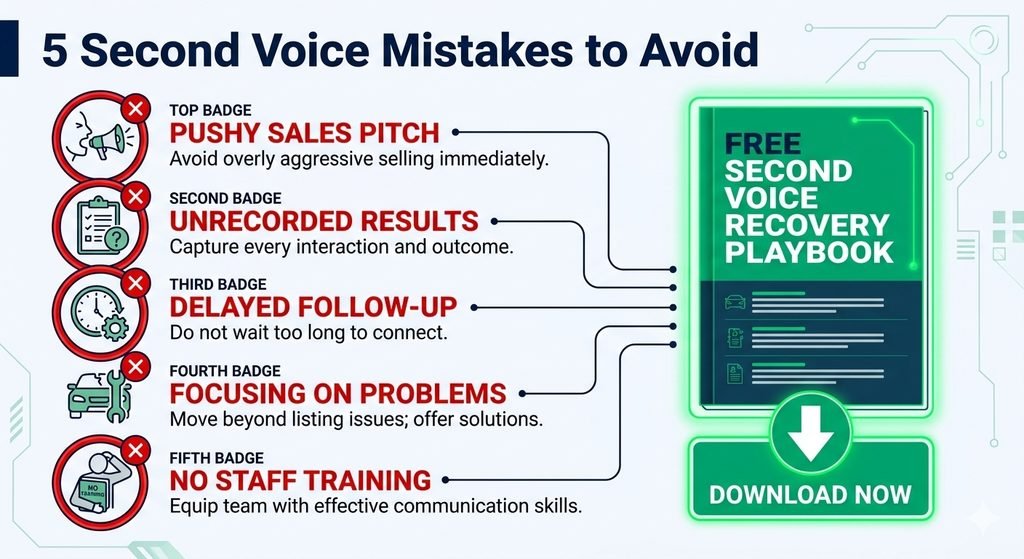
1. Cold calling without reviewing the estimate
The manager should know what was recommended before calling the customer.
2. Making the Call a Sales Pitch
The second voice should be one of clarity, not pressure.
3. Disregarding the Original Objection
If it’s price, it’s not going to solve the problem to repeat the same estimate.
4. Failure to Record the Result
It is hard to measure or improve an undocumented callback.
5. Treating All Customers the Same
Personalized interactions are created based on the customer’s experience, preferred communication method, repair type, and expressed concerns.
Example: One Recovered Estimate, One Callback
Sample only, not actual customer data.
Let’s say a customer gets a $1,200 estimate and says no because it’s more than they thought.
The advisor records the budget concern in the CRM.
Two days later, the service manager makes a trust-building callback. Instead of repeating the original estimate, the manager explains the documented repair findings, clarifies which work should be prioritized, and discusses an available payment option.
The customer decides to schedule the priority repair.
The lesson isn’t that every callback will recover an estimate.
It’s that a structured high-touch recovery process gives customers another informed opportunity to make a decision.
How Second Voice Recovery Supports Authorization Rate Optimization
The second voice method fits naturally into a broader revenue recovery framework:
Declined estimate → Manager callback → Objection identified → Clarification/options → Customer decision → CRM outcome
This makes the process measurable.
Instead of treating a declined estimate as the end of the journey, the shop creates a defined recovery stage before the opportunity is closed.
For the broader strategy, see our pillar guide: A Step-by-Step Guide to Boost Authorization Rates in Auto Repair.
Free Second Voice Recovery Playbook
Want to turn this process into a repeatable workflow?
Create a downloadable Second Voice Recovery Playbook for Auto Repair Shops containing:
- Manager callback script
- Objection-handling prompts
- Follow-up checklist
- CRM fields to track
- Callback KPI worksheet
- 24-48-72 hour follow-up framework
CTA: Download the free playbook and give your managers a practical framework for recovering declined repair opportunities.
For an exit-intent offer, use the same playbook rather than a generic newsletter popup. That keeps the offer directly connected to the reader’s current problem.
Conclusion
A declined estimate doesn’t have to become a dead end.
A well-timed second voice call gives the customer another chance to ask questions, understand the recommendation, and decide what works for them.
For the shop, the process creates something equally valuable: a measurable system for manager callback declined work, estimate recovery, and authorization rate optimization.
Start with one simple change. Don’t let every declined estimate disappear without a documented next step.
Frequently Asked Questions
What is second voice recovery in auto repair?
It is a manager-led follow-up with a customer who declined or deferred recommended work. The manager identifies the concern, provides clarification, and agrees on an appropriate next step.
When should a manager call after a declined estimate?
Check back while the estimate is still relevant, and the timing works with the repair and the customer’s communication style. Higher value or unresolved opportunities may warrant more personal follow-up.
What should a manager say during a declined repair callback?
Acknowledge last estimate, ask customer why they passed, identify the documented recommendation, discuss suitable options, agree on next step.
Should shops call, text, or email declined estimates?
Telephone should be the primary means of communication for second voice recovery calls. Telephone calls should be used for higher dollar or more complex repair work.
How do you measure second voice recovery?
Measure the number of calls made, the dollar value of repair work recovered, the reason for objections, and the level of authority to perform the repair work
Back to the previous article