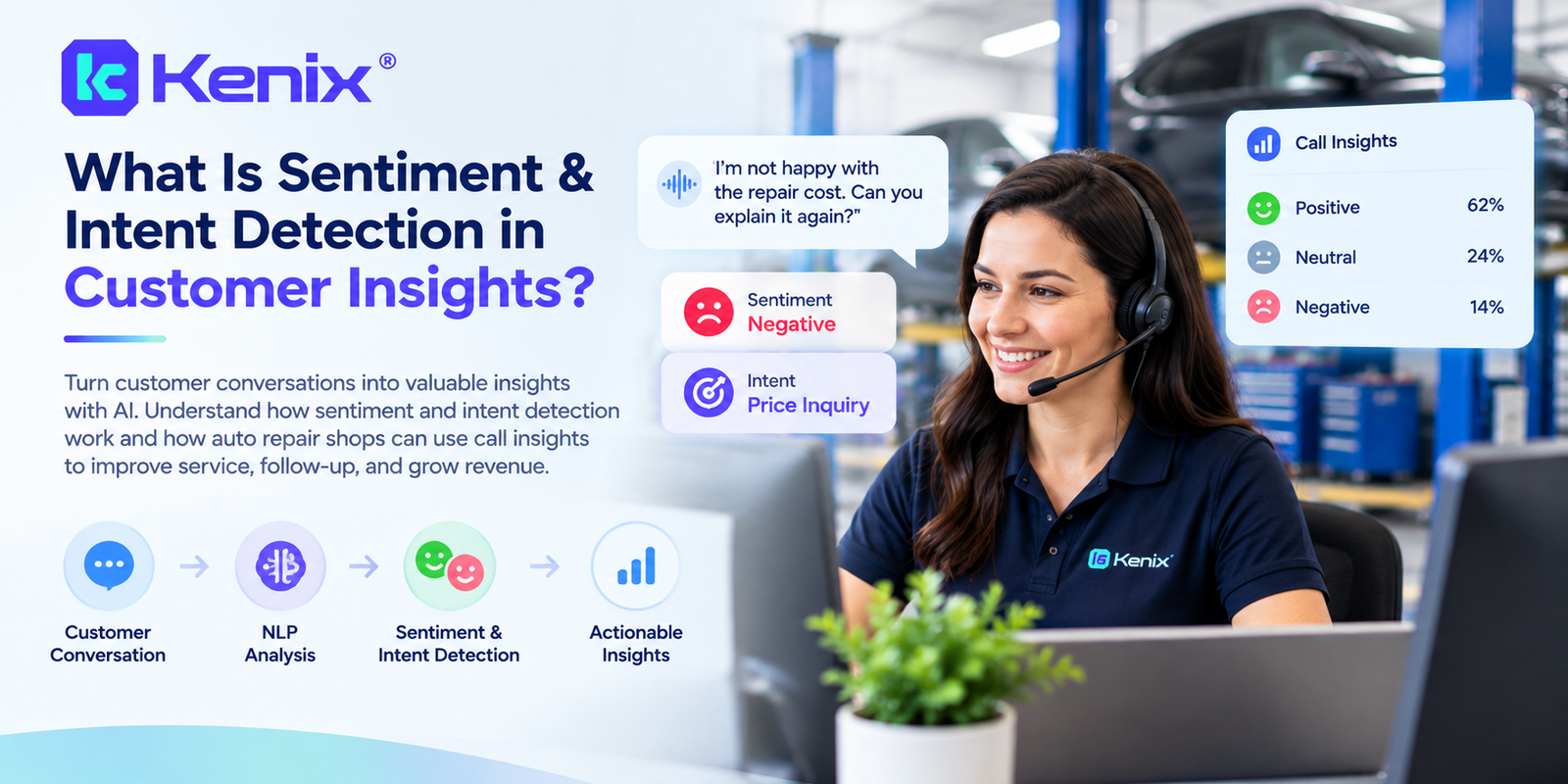
What Is Sentiment & Intent Detection in Customer Insights?
Objective
Explain how sentiment and intent detection work, how natural language processing supports them, and how auto repair shops can use call insights to improve customer service, follow-up, and revenue recovery.
Key Takeaways
- Sentiment detection looks at the emotional tone of a customer conversation.
- Call intent detection identifies the customer’s purpose or likely next action.
- Automotive call NLP can turn spoken conversations into useful customer insights.
- Shops can use these signals to improve advisor coaching, follow-up, bookings, and revenue recovery.
Introduction
A customer can sound calm on a call while quietly deciding not to book. Another may ask one simple pricing question but be ready to approve the repair. Sentiment analysis for auto repair calls, powered by AI call intelligence, can help your team spot these signals instead of relying only on what the customer says.
That is where call intent detection becomes useful. It helps to find out what the customer wants. Sentiment analysis looks at how the customer feels. Together, these signals can give an auto repair shop a clearer view of what is happening during customer calls.
What Is Sentiment Detection in Customer Insights?
Sentiment detection is the use of AI and language analysis to identify the tone or emotional direction of a conversation. Common categories are positive, negative, and neutral sentiment.
For example, a caller who says, “I’ve called twice, and nobody got back to me,” may be venting. A caller saying, “That works perfectly for me,” shows a very different customer response.
IBM explains that sentiment analysis can identify mood and emotion in content, while natural language understanding can also identify user intent and support customer service applications.
For repair shops, customer emotion detection can help managers spot conversations that need attention.
What Is Call Intent Detection?
Call intent detection identifies the reason behind a customer’s call. It answers a simple question:
What does this customer actually want?
A caller may want to:
- Book an appointment
- Ask about repair pricing
- Check vehicle availability
- Approve an estimate
- Reschedule a visit
- Cancel an appointment
- Ask whether a repair is urgent
Sentiment tells you how the customer feels. Intent tells you what the customer wants to do.
That difference matters. A customer can sound positive but still be undecided. Another can sound frustrated but still want to book the repair.
How AI Analyzes Customer Calls
Modern automotive call NLP uses language technology to process spoken conversations and identify useful signals.
1. Speech becomes searchable data
Speech recognition turns a recorded call into text. Then the system can analyze words, phrases, topics, and context.
2. NLP looks for meaning
Natural language processing allows software to analyze language, not just search for keyword counts. Conversation intelligence systems digest sentiment, customer intent, pain points, action items, and more signals.
3. The system identifies useful patterns
This may include:
- Customer emotion
- Customer intent
- Pricing concerns
- Booking signals
- Questions that remain unanswered
- Advisor responses
- Likely call outcomes
This is where call outcome prediction can support a manager. It should not be treated as a guarantee of what the customer will do. AI provides signals that help your team make better decisions.
Why Sentiment and Intent Matter to Auto Repair Shops

Here’s the thing: your phone calls already contain valuable customer information. The problem is that manually reviewing every recording takes time.
Sentiment analysis for auto repair calls can help your team identify conversations that deserve attention.
Improve Advisor Coaching
Instead of telling an advisor to “handle calls better,” managers can review specific patterns and coach around them.
For example, an advisor may answer pricing questions well but fail to ask for the appointment. That is a much more useful coaching point. Pairing these insights with call scoring lets managers grade every conversation against the same standard, and a smart whisper system can help advisors act on those signals while the customer is still on the line.
Find Missed Revenue Opportunities
Kenix says its AI Analysis listens to advisor conversations, scores how calls were handled, flags revenue that was nearly missed, and turns those findings into coaching that teams can use. Those flagged calls become the starting point for revenue recovery, so your team knows exactly which customers to contact first.
Improve Follow-Up
A call that ends with “I’ll think about it” should not automatically become a lost lead. The conversation may show that the customer needs a price explanation, more time, or a simple follow-up.
A Real-World Call Example
Imagine a customer calls about brake repairs.
They ask about the price, say the estimate is higher than expected, and then say they need to think about it.
A basic call report might simply record:
Outcome: Customer did not book.
A stronger analysis could identify:
| Call Signal | Example Insight |
|---|---|
| Sentiment | Concerned about price |
| Intent | Interested in the repair |
| Objection | Cost |
| Outcome | No booking yet |
| Next action | Follow up with the customer |
This is the practical value of call intent detection. Your team gets more context than a simple missed or completed call label.
How Kenix Uses AI Call Analysis
Kenix combines VoIP, CRM, AI call tracking, scheduling, and reputation management in one platform for auto repair shops. Its AI Analysis reviews advisor conversations and identifies missed revenue opportunities without requiring managers to review recordings manually.
The platform fills several revenue gaps such as missed calls, unbooked leads, no-shows, unapproved estimates, and missed review opportunities.
This makes sentiment analysis for auto repair calls more useful when it leads to an action. The goal is not simply to label a customer as positive or negative. Your team needs to know what happened, why it happened, and what should happen next.
A Simple Tip: Track Five Signals on Important Calls
If you manage an auto repair shop, start with these five questions:
- How did the customer feel?
- What did the customer want?
- What stopped the customer from taking action?
- What was the call outcome?
- What should your team do next?
This simple framework can turn raw call recordings into useful customer insights.
Turn Customer Conversations Into Better Decisions
When it comes to call emotion and call intent, auto repair calls have it all. With automotive call NLP, these signals can be captured and assessed at a scale that isn’t possible using manual call review.
The real value comes from acting on those insights. Better coaching, timely follow-up, clearer customer communication, and stronger revenue recovery can all start with understanding what happened during the call.
If your shop already records customer conversations, the next question is simple: are you actually using the information inside them?
Ready to see what your calls are really telling you? Learn how Kenix’s AI call intelligence can help your shop turn customer conversations into useful information and uncover missed revenue opportunities. Explore the full platform at Kenix.
Frequently Asked Questions
What do you mean by sentiment analysis in customer calls?
Sentiment analysis helps in understanding the emotional tone of the customer conversation, which could be positive, negative, or neutral. It could help identify signals like satisfaction, frustration, or concerns.
What is call intent detection?
It is the identification of the main purpose of a customer call. For an auto repair shop, this could be booking a service, seeking information about cost or timing, approving an estimate, rescheduling, or canceling.
How does NLP help analyze customer calls?
NLP helps AI understand the tone, sentiment, and intent of customer conversations once they are converted to a text format.
Can sentiment analysis enhance auto repair customer service?
Yes, it can help managers identify customer concerns and how advisors address those concerns. It can aid in determining the areas for performance improvement and can be helpful in coaching.
Can AI predict the outcome of a customer call?
Emotionally charged conversations are difficult to analyze. In addition, speech-to-text has a degree of inaccuracy. IBM has a knowledge base document stating that sentiment analysis is not 100% accurate.
Back to the previous article