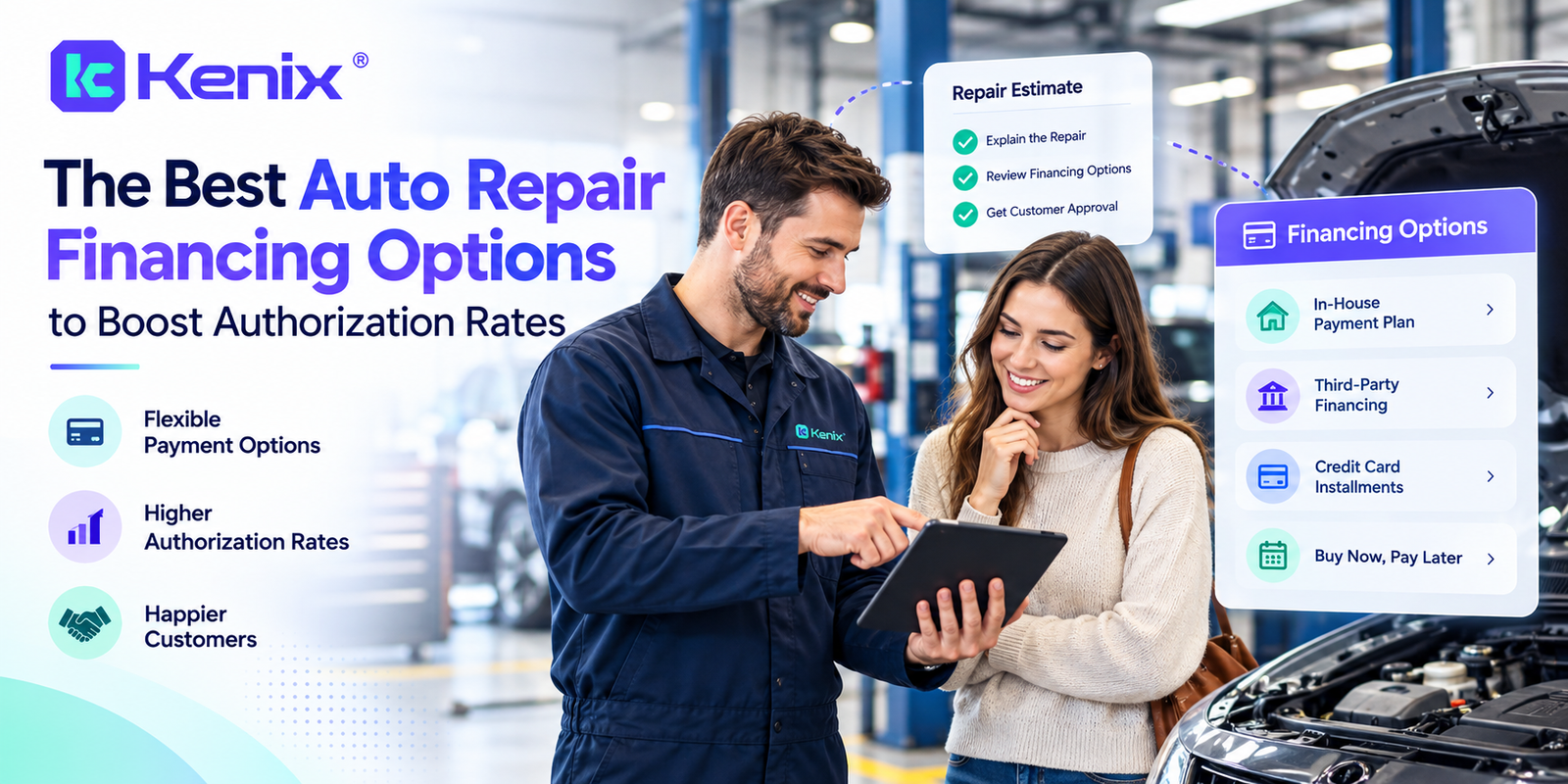
The Best Auto Repair Financing Options to Boost Authorization Rates
Key Takeaways
- If customers understand the need for repair, financing can help resolve affordability objections.
- Payment plans and financing through eligible credit are available options for auto repair financing.
- Terms of financing are more important than promoting low monthly payments.
- Financing should be presented after the explanation of the repair.
- Measure the impact of financing by tracking authorization rates and financing outcomes.
- Automation of CRM can be used by teams to manage pending estimates and financing follow-up.
- Kenix connects approval recovery, CRM, AI analysis, and other revenue recovery workflows to help shops keep missed opportunities visible.
Introduction
A customer can agree that their vehicle needs a repair and still leave without approving the estimate.
Sometimes the problem isn’t trust, urgency, or the repair itself. They simply can’t manage the full cost today.
For a service advisor, that distinction matters. The right auto repair financing options can give an eligible customer more payment flexibility without requiring the shop to discount legitimate work.
But financing isn’t a magic fix. If the customer doesn’t understand the repair, adding a payment plan won’t solve the real objection.
The better approach is simple: explain the repair, identify the affordability concern, present suitable options clearly, and let the customer decide.
Why Price Isn’t the Real Objection

When a customer says, “That’s more than I expected,” it doesn’t always mean the estimate is too expensive.
There are usually three possibilities.
The Customer Doesn’t Understand the Repair
If the recommendation hasn’t been explained clearly, financing won’t create confidence.
The advisor should explain what is wrong, why the repair is recommended, and what the estimate includes.
The Customer Wants the Repair but Can’t Pay Today
This is where payment flexibility can genuinely help.
The customer may accept the diagnosis but need another way to manage the immediate expense.
The Customer Is Focused Only on the Monthly Payment
A smaller monthly payment doesn’t necessarily mean a lower total cost.
The CFPB recommends comparing the APR, interest rate, loan length, monthly payment, and total amount financed rather than focusing only on the monthly payment. A longer term can reduce the monthly amount while increasing total interest.
The key insight: financing should solve an affordability problem, not a communication or trust problem.
Financing Options for Auto Shops
There isn’t one best financing method for every shop or customer.
The right option depends on eligibility, terms, costs, shop requirements, and the customer’s circumstances.
| Financing Option | How It Works | Main Consideration |
|---|---|---|
| In-house payment plan | Shop allows payment over an agreed schedule | Collection and compliance responsibilities |
| Third-party financing | External provider handles financing | Eligibility and provider terms |
| Credit card installments | Customer uses an eligible credit option | Interest, fees, and credit limits |
| Buy-now-pay-later | Customer repays through a provider | Provider terms and eligibility |
In-House Payment Plans
Payment plans and auto shop programs allow eligible customers to pay over an agreed schedule.
This can provide flexibility, but it also puts more responsibility on the shop.
Before introducing an in-house arrangement, establish:
- Written payment terms
- Payment deadlines
- Eligibility rules
- Documentation requirements
- Collection procedures
- Applicable legal requirements
Don’t treat an informal promise to pay later as equivalent to a professionally structured financing product.
Because consumer-credit requirements can vary, shops should obtain appropriate legal and accounting advice before creating an in-house credit program.
Third-Party Financing
With a third-party financing arrangement, the responsibility for collection is significantly reduced.
It is important to explain the terms of the actual provider rather than simply stating that monthly payments are low.
The CFPB states that APR includes interest and certain fees and is a measure of the cost of credit.
Credit Card Installments
Some customers may prefer using an existing credit card or an eligible installment feature.
The advantage is familiarity and convenience.
The downside is that interest rates, fees, and repayment terms can vary considerably.
The customer should understand the total cost, not just whether the monthly payment fits their budget.
How to Present Financing
The way advisors introduce financing can matter as much as having financing available.
Step 1: Explain the Repair First
Generally, it is best to present financing as the last step.
Follow this order:
Problem → Evidence → Recommended Repair → Cost → Payment Options
Customers often overlook the step of presenting the repair.
Step 2: Understand the Real Reason for the Objection
Customers often state something like, “I know it needs to be fixed, but I can’t pay that much right now.” This is an affordability objection.
Now financing may be applicable.
Step 3: Explain the Available Option
It is important to cover the following when providing financing:
- Payment amount
- APR
- Total cost
- Number of payments
- Eligibility
The CFPB has guidance that advises consumers to review loan disclosures and understand the amount financed, total costs, and other terms prior to agreeing.
Step 4: Let the Customer Compare and Decide
The goal is customer objection handling, not closing at any cost.
A customer should be able to make an informed decision without feeling pressured.
When to Offer Financing
Financing is most relevant when three conditions exist:
- The customer understands the repair.
- The customer accepts that the repair is needed.
- Upfront cost is the main barrier.
Don’t use finance to compensate for:
- Poor estimate descriptions
- No evidence of inspection.
- There is no customer trust
- Ambiguous recommendations
- Unwanted repairs
This is a critical component for optimizing authorization rate.
Better authorization comes from removing legitimate barriers, not pushing customers past valid concerns.
How Kenix Fits Into Financing and Revenue Recovery
Financing is only one part of the authorization journey.
A customer might understand the repair, ask about financing, leave the estimate pending, and never respond again. That’s where the broader revenue recovery framework becomes important.
Kenix is an auto repair shop revenue recovery platform, including VoIP, CRM, AI Call Tracking, smart scheduling, and reputation management. Its Approval Recovery capability focuses on pending estimates and visibility into the dollars being authorized.
A financing-related workflow could look like:
Estimate → Affordability Objection → Financing Option → Customer Decision → Authorization → CRM Update → Follow-Up
The financing itself doesn’t need to be a Kenix product for Kenix to be relevant to the workflow.
Instead, Kenix can help shops keep approval opportunities visible within the wider customer journey.
For estimates that stay pending, see how second voice recovery can help your team reconnect with the customer.
Where CRM Automation Helps
A connected CRM workflow can help teams identify customers who:
- Have a pending estimate
- Need follow-up
- Have not completed an expected next step
- Previously declined recommended work
- Need another conversation
Kenix says its CRM keeps leads visible, and its connected platform allows customer information and actions to flow between its systems.
That makes financing follow-up part of a broader approval recovery process rather than a standalone conversation.
Case Study: Recovering a Pending Repair
Consider this illustrative example, not verified industry data.
A shop presents 100 eligible estimates.
- 60 are immediately approved.
- 20 are declined.
- 20 remain pending.
The service manager reviews the pending estimates and discovers that several customers understand the repairs but are concerned about the upfront cost.
The shop introduces an appropriate financing option and trains advisors to mention it only when affordability is the customer’s actual concern.
Suppose five customers subsequently authorize their repairs.
The important lesson isn’t the number five.
It’s why those approvals happened.
Financing didn’t create the need for the repairs. It removed an affordability barrier for customers who already understood the recommended work.
A Kenix-enabled recovery workflow could then help the shop keep those estimate outcomes visible alongside its broader customer and approval data. Kenix specifically identifies unapproved estimates as one of the revenue gaps its platform is designed to address.
How Financing Can Affect the Authorization Rate
Consider the same hypothetical shop.
Before the financing workflow:
60 approved estimates ÷ 100 eligible estimates × 100 = 60% authorization rate
If five additional customers authorize legitimate repairs after choosing an appropriate financing option:
65 approved estimates ÷ 100 eligible estimates × 100 = 65% authorization rate
That’s a 5 percentage-point increase in this hypothetical example.
It does not mean financing guarantees a 5-point improvement.
Actual results depend on the customer’s reason for declining, repair value, financing availability, customer eligibility, advisor communication, and other factors.
The calculation simply shows how a shop can measure whether recovered approvals are changing its own baseline.
Track Financing Impact on Authorization Rate
Don’t assume financing is working simply because customers use it.
Measure the results.
Track:
- Overall authorization rate
- Financing offers
- Financing applications
- Financing approvals
- Repairs authorized after financing
- Average approved estimate
- Recovered revenue
- Financing-related drop-offs
- Average time from estimate to authorization
Establish your baseline first.
Then compare performance after introducing or changing your financing process.
This gives your shop authorization KPI real context.
Kenix also provides a KPI dashboard and positions its platform around measuring revenue recovery outcomes, which fits naturally with this measurement approach.
Free Auto Repair Financing Conversation Guide
Turn this article into a practical lead magnet:
Free Auto Repair Financing Conversation Guide
Include:
- Affordability objection checklist
- Advisor conversation prompts
- Financing comparison worksheet
- Customer follow-up checklist
- Authorization KPI tracker
Download the free financing conversation guide to help your service advisors handle affordability objections clearly and consistently.
For an exit-intent popup, keep the offer relevant:
Before you go, download the free Auto Repair Financing Conversation Guide and give your team a clearer way to handle price objections.
This is more useful than asking readers to subscribe to a generic newsletter.
Conclusion
The right auto repair financing options can help remove affordability as a barrier when a customer already understands and wants the repair.
The best approach is simple: explain the repair, identify the customer’s concern, present transparent payment options, and let them decide.
When combined with CRM automation, Approval Recovery, and the broader revenue recovery framework, financing can become part of a more consistent authorization process.
For shops using Kenix, this creates an opportunity to keep pending estimates and customer follow-up visible instead of letting potential revenue disappear.
The goal isn’t to pressure customers. It’s to make legitimate repairs easier to understand, easier to manage, and easier to authorize.
Frequently Asked Questions
Can financing increase auto repair authorization rates?
It can help when upfront cost is the customer’s main barrier. It won’t solve problems caused by poor communication, unclear repairs, or lack of trust.
What are the best auto repair financing options?
Common options are third-party financing, shop payment plans, and available credit-based payment options. Which is right depends on terms, eligibility, cost, and shop needs.
Can an auto repair shop offer payment plans?
Some do, but expectations and dangers differ. Before offering in-house financing, shops should set up clear terms and review applicable consumer-credit, tax, and legal considerations.
When should a service advisor mention financing?
Present it after the customer understands the repair and indicates that upfront cost is preventing authorization.
Does financing guarantee higher authorization rates?
No. Financing can reduce an affordability barrier, but shops should measure their own results rather than assume a guaranteed improvement.
Back to the previous article