Transform Your Auto Repair Business with AI Transcription

Objective
The objective of this blog is to explain how AI transcription can improve client service, coach advisors, and regain lost revenue through transcribed phone calls.
Key Takeaways
- AI can accurately transcribe recorded phone calls.
- Recording outbound and inbound repair calls provides a clear record of discussions for the repair team.
- Searchable call logs help quickly find calls in need of follow-up or audit.
- Call transcripts can uncover communication and approval gaps.
- Shops should understand the laws pertaining to call recording with customers prior to recording customers.
Introduction
A missed customer call can mean more than a missed conversation. It can mean a lost booking, an unanswered repair question, or an estimate that never gets approved. For busy repair shops, reviewing every call by hand is not practical.
This is where AI call transcription technology for the auto repair industry can assist. Combined with AI call intelligence, it provides the means to review calls, catch up with advisors, and uncover follow-up opportunities.
Did you know? The Federal Trade Commission notes that state laws can differ on telephone call recording and consent requirements. That makes a clear recording policy important for any shop using recorded customer calls.
Why Call Recording Alone Is Not Enough
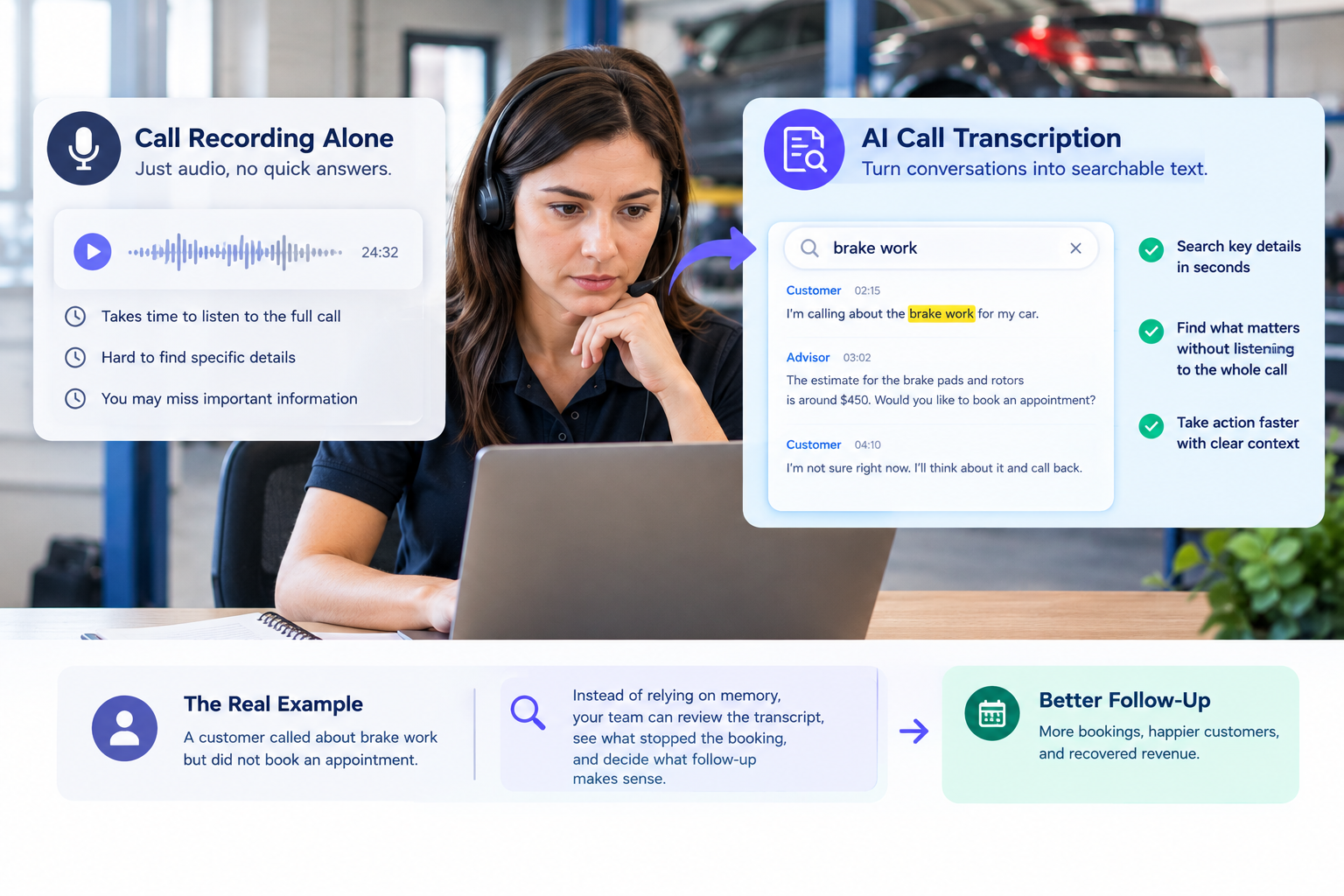
Recording a customer call gives you the audio, but finding one important detail can still take several minutes. A manager may need to listen to an entire conversation just to confirm what a customer said about an estimate.
AI call transcription auto repair tools solve this problem by converting spoken conversations into text that your team can search and review.
Think about a customer who called about brake work but did not book an appointment. Instead of relying on memory, your team can review the transcript, see what stopped the booking, and decide what follow-up makes sense.
The value is not simply storing more calls. It is making those calls useful.
How AI Transcription Works
From Call to Searchable Text
The process is straightforward:
Customer call → recording → automatic transcription → searchable archive → review → action
This gives your team both the original audio and a written record.
Build a Voice-to-Text Shop Workflow
A voice-to-text shop can use transcripts to review:
- Repair questions
- Appointment requests
- Estimate discussions
- Customer objections
- Follow-up promises
Reduce Manual Notes
Instead of asking advisors to type every conversation into a system, automated transcription can create a written record from the call. Kenix says its VoIP system records and transcribes calls automatically and logs them into its zero manual entry CRM.
Make Customer Calls Easier to Search
A busy service manager rarely has time to listen to dozens of recordings every week. A searchable archive changes that.
With searchable call logs and smart call tagging, your team can quickly locate conversations about estimates, appointments, services, or follow-up requests.
You can also use call playback when the exact tone or wording matters. The transcript gives you speed, while the original recording provides context.
This is especially useful when a customer calls back and says, “What did we discuss last time?” Your advisor has a better record to work from.
Improve Service Advisor Performance
Good phone handling matters in an auto repair shop. Advisors need to explain repairs clearly, answer questions, and guide customers toward the next step without sounding pushy.
Call transcripts can give managers real examples for coaching.
For instance, suppose several calls show customers asking about the price of a repair and then ending the call without booking. Instead of guessing why bookings are being lost, a manager can review those conversations and look for common patterns.
Kenix uses AI call analysis to review advisor conversations, assess how calls were handled, flag possible missed revenue, and provide coaching information.
This is where AI call intelligence becomes more useful than simple call recording.
Use Call Records for Better Protection
Good records can also help when a customer questions what was discussed.
A transcript and recording can support internal review when there is a disagreement about an appointment, estimate, or conversation. That can make dispute resolution easier for your team.
But there is an important point: recording laws differ across states. The FTC advises businesses to check applicable requirements because state rules can vary regarding telephone recording and consent.
Your shop should therefore have a clear recording policy and make sure your process follows the laws that apply to your business.
Turn Call Insights Into Revenue Recovery
The strongest use of transcription is not simply saving time. It is finding missed opportunities.
A call may reveal that:
- A customer wanted an appointment but never booked.
- An estimate was discussed but not approved.
- An advisor promised a follow-up.
- A customer had another repair question that was not addressed.
When call information feeds into a CRM, teams can act on these gaps faster. Kenix positions this workflow around a zero-manual-entry CRM, smart call tagging, AI analysis, and revenue recovery.
The result is a more useful record of what customers actually said and what your team needs to do next.
A Simple Step to Start Today
Take your next 20 recorded calls and review them for four things:
- Missed bookings
- Unanswered customer questions
- Estimate objections
- Promised follow-ups
Look for patterns rather than isolated mistakes. If the same issue appears several times, turn it into a coaching topic or follow-up process.
That small review can show you where your phone process needs attention before you invest more money in attracting new leads.
Turn Every Customer Call Into Useful Business Data
Auto repair call recording becomes much more valuable when your team can search, review, and act on what customers actually said. AI transcription gives shop owners a faster way to understand calls without manually reviewing every recording.
Kenix brings call recording, transcription, CRM, and AI call analysis into one platform designed for auto repair operations. If your shop wants to see where calls are being lost or where follow-up can improve, explore the platform and see how its call intelligence can fit your workflow.
Ready to act on every conversation? See how Kenix can help your shop turn customer calls into better follow-up and revenue recovery.
FAQs
What is AI transcription for an auto repair shop?
AI transcription is the process of converting recorded customer conversations to text. Your staff can review and use customer information to better address service needs.
How does call transcription help service advisors?
With call transcription, service advisors and managers have a written record of conversations, which can be used for coaching, follow-up, and customer service.
Is call recording for an auto repair shop legal?
Legality varies from state to state and situation to situation. It’s best practice for your shop to consult legal counsel to understand your obligations and/or call recording disclosures.
Can call transcription help increase repair bookings?
Call transcription helps find calls where a customer may have expressed interest in making a repair, but didn’t book the service, giving your staff information to improve their follow-up.
What should I look for in transcription software for my auto repair shop?
It’s best practice to look for out-of-the-box transcription, automated playback of calls, call records, CRM integration, call analysis, and features that assist staff in following up with customers and addressing service needs.
Back to the previous article