
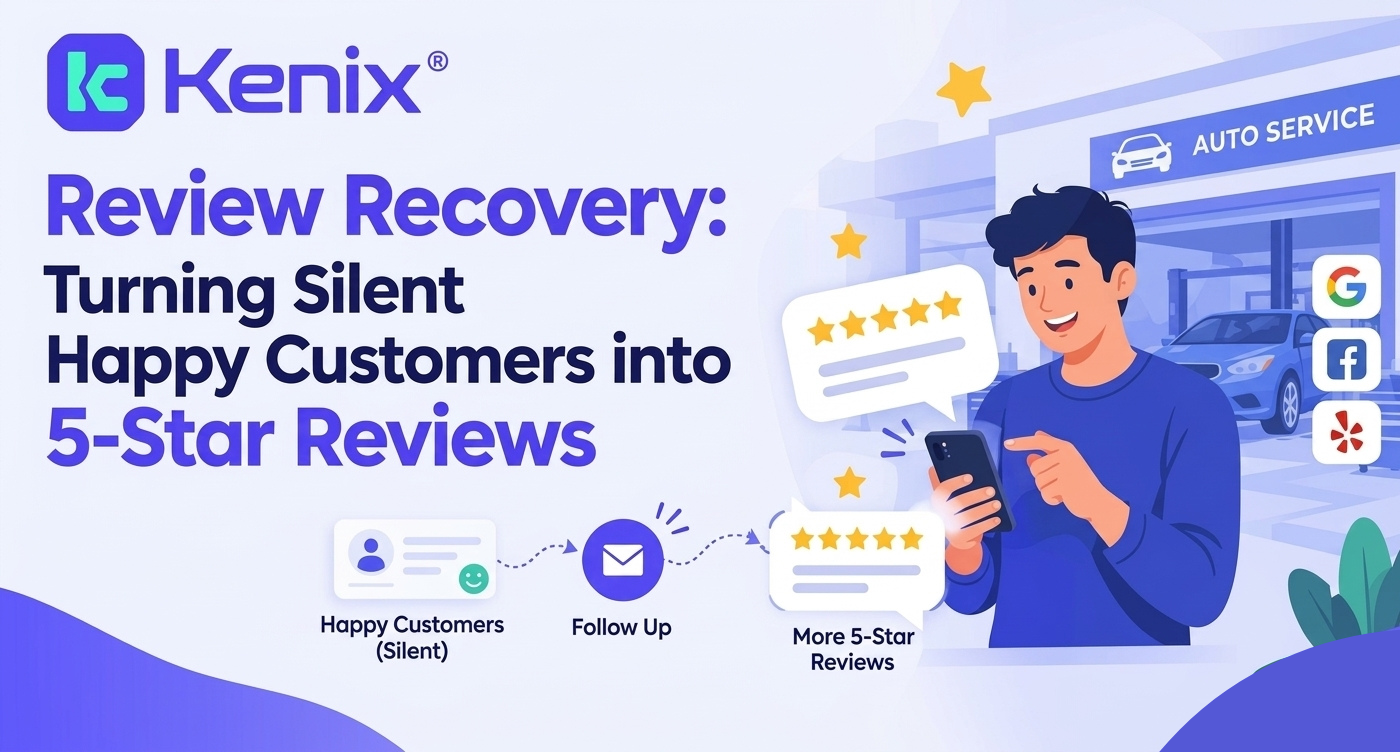
Review Recovery: Turning Silent Happy Customers into 5-Star Reviews
Objective
This guide explains how review recovery auto-repair strategies can help your team turn positive customer experiences into authentic Google reviews while being consistent, compliant, and easy to use.
Key Takeaways
- A simple reminder can go a long way toward getting those happy customers to write you a review.
- Automation of review requests means follow-up is consistent.
- Help your team make it easy for customers to find your Google review page.
- You can use sentiment tracking to spot repeating customer issues.
- Review recovery should not be used to game the ratings, but to provide real feedback.
Introduction
A customer picks up their vehicle, thanks your service advisor, and leaves satisfied. Then the day gets busy, and that customer never leaves a review. Review recovery auto repair gives your team a practical way to close that gap by asking satisfied customers for honest feedback at the right point after service. Google allows businesses to share a direct review link or QR code through receipts, emails, chats, and other customer touchpoints, making it easier for customers to respond. The key is to make the request simple without trying to control what customers say. In this guide, we’ll explain how review request automation, customer feedback, and reputation recovery can help your shop build a more consistent review process.
Table of Contents
- Why Happy Customers Stay Silent
- What Review Recovery Means for Auto Repair Shops
- How to Build a Simple Review Recovery Process
- Turn Feedback Into Reputation Recovery
- Measure What Matters
- How Your Marketing Team Can Support Reviews
- FAQs
Why Happy Customers Stay Silent
Your customers have plenty of things competing for their attention after a repair. Even when they are pleased with your work, leaving a review may not be high on their list.
That creates a missed opportunity for your shop.
Satisfaction does not guarantee a review.
A customer can appreciate your service, trust your technician, and still leave without saying anything online.
This is why getting more auto repair reviews should not start with asking harder. It should start with making the process easier.
Timing matters
Ask at the right point in the customer experience, when the repair has been completed, and the customer has had a chance to confirm that everything went well.
That moment can be your peak goodwill point.
Make the next step simple.
Google lets businesses create a direct review link or QR code that can be shared through receipts, thank-you emails, chat, and other customer touchpoints.
The fewer steps your customer has to take, the easier it is to act.
What Review Recovery Means for an Auto Repair Shop

Review recovery is a structured process for following up with customers after service and giving them a convenient opportunity to provide genuine feedback.
It combines customer follow-up, auto repair review generation, feedback monitoring, and review responses.
Think of it this way:
| Traditional approach | Review recovery approach |
| Advisor remembers to ask | Request is part of the workflow |
| Follow-up varies by employee | Process stays consistent |
| Reviews are checked occasionally | Feedback is monitored regularly |
| Problems may be noticed late | Sentiment can reveal recurring issues |
The goal is not to create positive reviews that do not reflect real experiences. Google requires reviews to represent genuine customer experiences and prohibits incentives in exchange for posting, changing, or removing reviews.
How to Build a Simple Review Recovery Process
Here is a practical process your repair team can use.
Step 1: Identify the right moment
Start when the service is complete, and the customer has had an opportunity to confirm the outcome.
Step 2: Send a clear request
Keep the message short and provide a direct Google review link. You can also use a QR code at appropriate customer touchpoints.
Step 3: Use review request automation
Busy service advisors cannot manually remember every follow-up. Review request automation can help to make the process consistent across daily repair orders and multiple locations.
Step 4: Monitor customer sentiment
Do not only count reviews but look for repeated comments about pricing, communication, wait times, repair quality, and staff service. That is where sentiment tracking becomes useful.

Turn Feedback Into Reputation Recovery
Reviews are not only marketing material. They are also customer feedback.
A negative review may point to a communication problem, an unclear estimate, or an experience that did not meet expectations.
Your response should focus on the actual concern.
Use AI review responses with human oversight
AI review responses can help your team draft replies faster, but every response still needs human review. It should be accurate, respectful, and relevant to what the customer actually said.
Do not suppress negative feedback.
A strong reputation is built on credible customer experiences, not a perfect-looking review page.
The FTC’s consumer review rule prohibits businesses from buying positive or negative reviews and addresses deceptive review practices.
This makes ethical reputation recovery an important part of your process.
Measure the Review Recovery Process
If you want to get more auto repair reviews, track the process instead of looking only at your star rating.
Your weekly reputation KPI dashboard can include:
- Number of eligible customers
- Review requests sent
- Reviews received
- Request-to-review rate
- Average rating
- Unanswered reviews
- Common sentiment themes
These numbers tell you where your process is working and where your team needs attention.
This can also fit into a broader revenue recovery framework, where your shop looks at missed opportunities across the customer experience rather than treating reviews as a separate marketing task.
Make Reviews Part of Your Wider Marketing
Your review process works better when it supports the rest of your marketing.
- Build a Website That Actually Converts Visitors Into Customers: Show genuine customer feedback where it helps prospects understand your service.
- Invest in Local SEO Before Spending More on Advertising: Keep your Google Business Profile accurate and actively managed.
- Track Marketing Metrics That Actually Matter: Monitor review activity alongside calls, leads, and customer actions.
- Create Content That Answers Customer Questions: Use recurring customer questions to create useful service content.
- Optimize for Mobile Users: Make your review links and website easy to use on a phone.
- Use Email Marketing to Stay Top of Mind: Include appropriate post-service communication in your customer follow-up.
- Review Your Marketing Performance Every Week: Spend a short weekly session checking reviews, responses, sentiment, and request activity.
With Kenix, auto repair shops can integrate customer and reputation activities into a system designed just for them.
Turn Great Service Into Visible Customer Feedback
Your shop may already have satisfied customers. The missing piece may simply be a consistent process that makes it easy for them to speak up.
Start with the basics: ask at an appropriate time, provide a direct review link, keep your request honest, and respond to feedback professionally.
Then measure what happens.
When you treat review recovery auto repair as part of your customer process rather than a one-off marketing task, your team has a clearer way to turn good service experiences into genuine customer feedback.
Ready to improve your review process? Review your current follow-up workflow, identify where customers are being missed, and see how Kenix can support your broader reputation management process.
1. How can an auto repair shop get more Google reviews?
Include a request for a review in your standard process after a service is completed. Include a Google review link or QR code for your customers.
2. What is review recovery in auto repair?
Review recovery is the process of inviting customers to provide feedback after service is completed.
3. When should you ask for an auto repair review?
A review request should be made after the service is completed and the customer has affirmatively confirmed that the service was completed to their satisfaction.
4. Can review request automation help an auto repair shop?
Yes. Automating review requests is a good option because it releases your staff from the burden of following up with customers to request reviews.
5. Can you offer a discount for a 5-star review?
No. Review requests cannot be combined with an offer, discount, or promotion. Further, Google has policies in place to prohibit changes to reviews or the removal of reviews. The FTC also prohibits reviews from being solicited in a manner that conditions the offer on the review being a positive review.
Back to the previous article