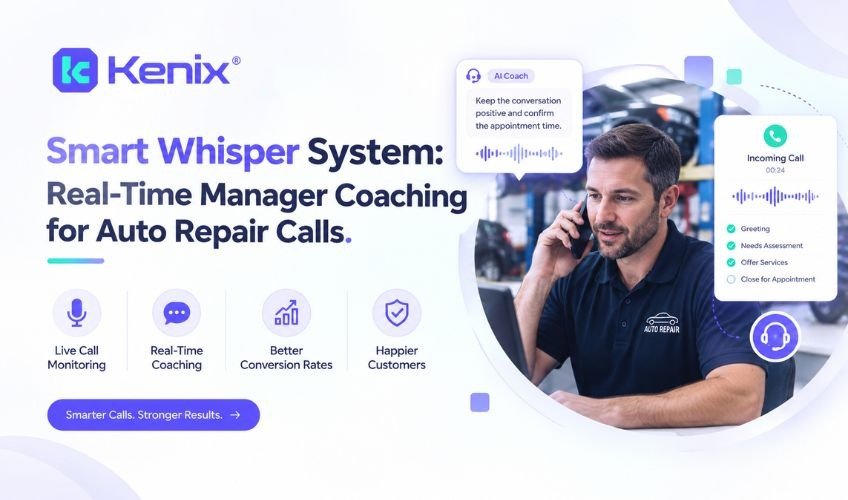
Smart Whisper System: Real-Time Manager Coaching for Auto Repair Calls
Objective
Our goal is to explain how call whisper manager technology can support service advisors, give managers better visibility into important calls, and turn conversation data into useful coaching opportunities.
Key Takeaways
- Providing an advisor with real-time call coaching support while the advisor is on the call can be beneficial.
- Manager call assist can help managers prioritize calls where assistance is needed.
- Customer context can give advisors a starting point.
- Call scoring can help managers review advisor performance.
- Call data can help teams identify follow-up and revenue recovery opportunities.
Introduction
If you manage an auto repair shop, you know how quickly a phone conversation can move. One customer wants a repair estimate. Another is asking why a recommended service costs more than expected. Someone else wants an appointment while your advisor is already helping a customer at the counter.
The problem is not simply answering calls. It is helping your team handle important conversations well, even when the shop is busy.
That is where a smart whisper system auto repair solution can make sense. With real-time call coaching, your advisors can receive useful support during a conversation while still doing the talking themselves.
The need for strong automotive teams is clear. The U.S. Bureau of Labor Statistics reports that automotive service technicians and mechanics held about 805,600 jobs in 2024 and projects about 70,000 openings each year from 2024 to 2034. This does not prove that AI coaching improves business results, but it does show the size and continuing importance of the automotive service workforce.

Table of Contents
- What Is a Smart Whisper System?
- How Does It Work?
- The Advisor Experience
- From Call Data to Coaching
- FAQs
What Is a Smart Whisper System?
A smart whisper system is an AI-assisted support tool that can provide information or guidance to a service advisor during a live customer call without taking over the conversation.
That distinction matters. It is not the same as an AI receptionist that speaks directly with the caller. With whisper technology, the advisor remains the person handling the conversation while useful information or prompts can be presented to them.
For example, a pre-call briefing could give an advisor available customer information before the conversation starts. During the call, live call guidance may help the advisor stay focused on the customer’s needs.
A call whisper manager setup can also give managers a way to support conversations without taking control of every call.
The aim is simple: give your people useful information at the moment it can help.
How Does Real-Time Call Coaching Work?
A practical workflow can look like this:
Caller identification → customer context → available vehicle information → live guidance → advisor action → manager review

Caller ID + CRM Lookup
When connected systems support it, caller information can help identify an existing customer and surface available records. This can save an advisor from asking questions the shop already has answers to.
Kenix is positioned as an automotive customer engagement platform, and public product descriptions say it can integrate with shop management systems to synchronize customer, vehicle, and service information.
Vehicle History Popup
Vehicle and service history can be useful when a returning customer calls. An advisor who can see relevant information has more context for the conversation than someone starting with an empty screen.
The exact information available will depend on the systems and integrations your shop uses.
Revenue Opportunity Alert
Consider a customer who calls about a warning light but ends the conversation without booking an appointment. That call may deserve follow-up.
AI call intelligence can help organize and analyze call information so your team can identify conversations that may need another look. It should not be presented as a guarantee of a sale or additional revenue.
The Manager Experience
Most managers cannot listen to every customer call from beginning to end. Even in a well-run shop, there are technicians to support, customers at the counter, estimates to review, and operational issues to handle.
This is where manager call assist can be useful.
Instead of treating every call the same, managers can focus on conversations that may need attention. After the call, call scoring and conversation data can also help identify patterns.
For example, you may find that an advisor regularly handles technical questions well but struggles when customers question price. That gives you a specific coaching topic instead of a vague instruction to “do better on calls.”
For multi-location operations, consistent call data can also help managers compare advisor performance across locations.
The Advisor Experience
Your service advisor should remain at the center of the customer conversation.
Good advisor coaching should not mean forcing employees to read a script. Customers can tell when a conversation sounds mechanical.
Instead, the useful question is: what information would help this advisor right now?
Imagine a customer asks:
“Why does this repair cost so much?”
The advisor needs to explain the work clearly, address the concern, and help the customer decide on the next step. Relevant live call guidance can support that process without replacing the human conversation.

A Practical Auto Repair Call Example
Let’s say a returning customer calls because a dashboard warning has appeared.
The advisor has available customer and vehicle context before the call progresses. The customer then asks about repair cost and whether an appointment is needed.
Rather than switching between several systems while trying to keep the conversation moving, the advisor can use the available information and guidance to stay focused on the caller.
The manager does not need to take over automatically. Afterward, the conversation can provide useful information for coaching.
This is where AI call intelligence becomes practical. The value is not simply collecting calls. It is helping your team learn from them.
From Call Data to Better Coaching
A smart whisper system should be judged by what your team can do with the information, not by how many AI features appear on a product page.
| Call signal | What it can tell your manager | Possible coaching action |
| Price objection | How well the advisor explains value | Review objection handling |
| No appointment | Where the conversation stopped | Improve next-step language |
| Repeated questions | Where customers need more clarity | Review advisor explanations |
| Missed follow-up | Which calls may need another action | Strengthen follow-up process |
| Strong call outcome | What the advisor did well | Share the behavior with the team |
This is also where call scoring and agent performance data can become useful. Kenix is positioned around customer engagement, phone communication, appointment scheduling, analytics, and revenue-related outcomes for automotive repair businesses.
The important point is to keep the claim realistic: better data does not automatically create revenue. It can give managers clearer information for coaching, follow-up, and process improvement.
Better Calls Start With Better Support
A smart whisper system auto repair solution should not replace an experienced service advisor or manager. It should support them.
When your advisor has useful customer context, your manager has better visibility, and your team can review call scoring and performance patterns, coaching becomes more specific.
The best question is not, “Can AI talk to our customers?”
It is:
“Can AI help our people handle important customer conversations better?”
For an auto repair operation, that is where the real value of real-time call coaching starts.
Ready to Improve Your Call Process?
If your shop wants a clearer view of customer calls, advisor performance, and follow-up opportunities, explore how Kenix approaches customer communication and AI-powered tools built specifically for auto repair businesses.
Frequently Asked Questions
1. What is a smart whisper system for auto repair shops?
A smart whisper system uses AI to help service advisors during live customer phone calls. The advisor is continuously responsible for the call.
2. How does real-time call coaching help service advisors?
Service advisors can remain focused on answering customer questions and addressing customer concerns. It suggests helpful information to help the advisors focus on the next steps to guide the conversation.
3. What is the difference between call monitoring and call whispering?
For call monitoring, a manager listens to and reviews the calls. The advisor receives call information and coaching from a real-time assistant for call whispering.
4. Can AI improve auto repair call performance?
Using AI for call analytics, call scoring, and coaching is useful for organizing and analyzing data. The results depend on the AI system, data access, system configuration, and your team.
5. Does a smart whisper system replace service advisors?
No. A whisper system augments human-to-human communication, not replaces it. An advisor still needs to interpret the customer, explain themselves, and make good decisions regarding the situation.
Back to the previous article