
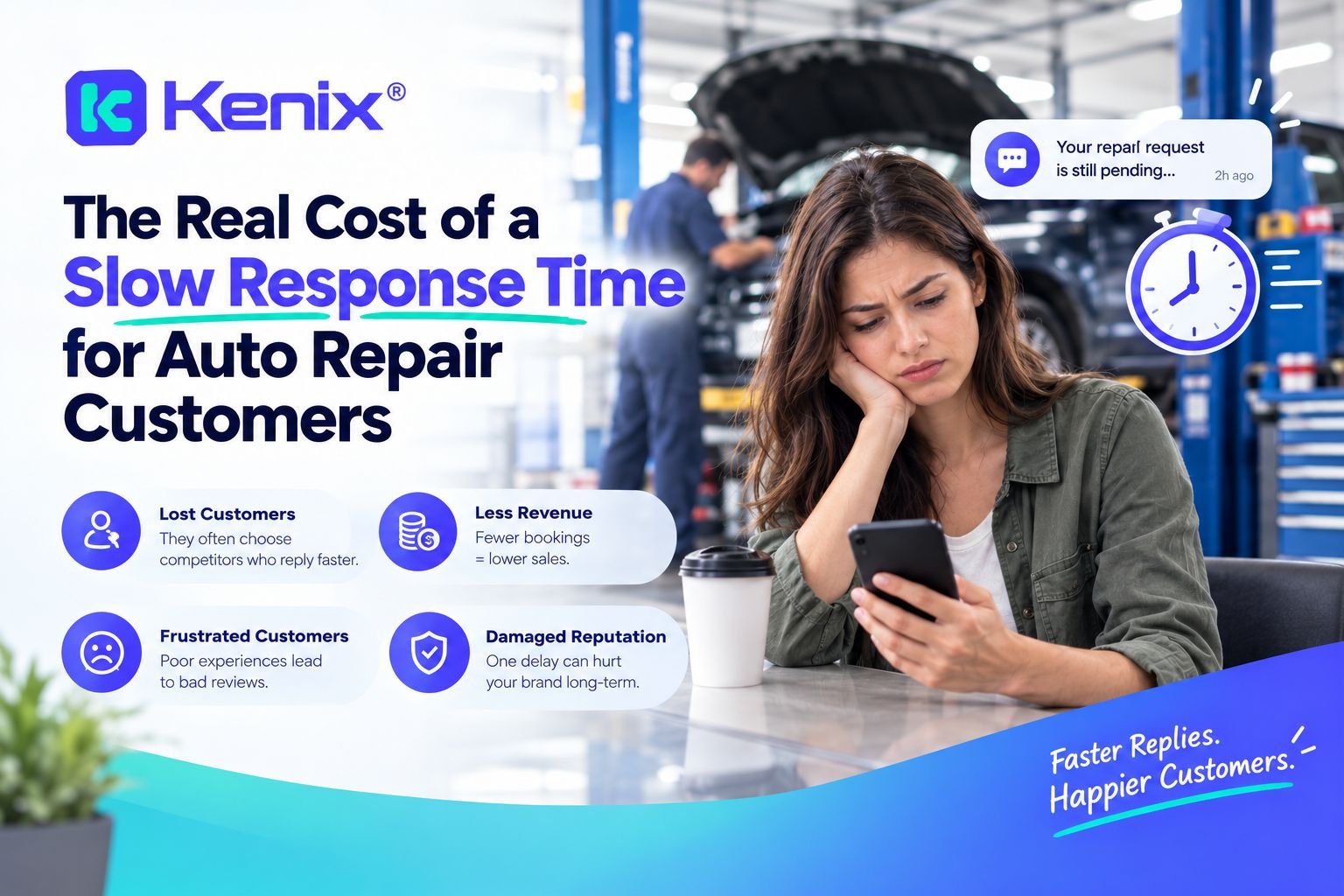
The Real Cost of a Slow Response Time for Auto Repair Customers
The search results came through in the error details; I have what I need. The data confirms current ARO figures around $419–$428 and corroborates the speed-to-lead statistics. I have sufficient verified data to write the article now.
A driver’s check engine light comes on during their commute. They text three shops, fill out a web form on a fourth, and leave a voicemail at a fifth. The first shop to respond, a place they’ve never heard of, gets the appointment. The others never had a chance.
That’s not a missed call problem. That’s a multi-channel response failure that costs real money, every single day.
What Customers Actually Expect, And How Fast They Move On
Consumer patience for slow responses has effectively reached zero. According to research from Demand Local and Rep.ai, 82% of consumers expect a response within 10 minutes, regardless of whether they called, texted, or submitted a web form. Most auto repair shops aren’t remotely close to that standard.
The underlying psychology is straightforward: when someone reaches out about a car problem, their intent is at its peak in that moment. Every minute of silence erodes it. Drift’s research quantifies exactly how fast this happens; waiting just 5 minutes after an inquiry increases the risk of losing that lead by 10x. Waiting 10 minutes pushes the risk to 100x.
The Harvard Business Review’s landmark speed-to-lead study, still the industry’s definitive benchmark, found that responding within 5 minutes makes a lead 21x more likely to convert compared to a 30-minute delay. Velocify’s data pushes this further: responding within the first minute drives a 391% increase in conversions. These aren’t B2B software statistics. They apply directly to any local service business where urgency drives the inquiry, and few situations are more urgent than a car that won’t start.
It’s Not Just Phone Calls, Every Channel Has Its Own Decay Clock
Most articles about auto repair shop communication focus on missed calls. That’s the right problem to worry about, but it’s only part of it. Web form submissions, SMS inquiries, and voicemail callbacks all carry their own response-time window — and most shops treat them as lower priority than live calls. That’s a costly mistake.
Web form submissions submitted during business hours should receive a response within 5–15 minutes. One hour is the outside limit before conversion probability drops sharply, according to BizClearAI’s local service benchmarks. In practice, most shops route form notifications to a general email inbox that nobody monitors actively — meaning a high-intent estimate request can sit unanswered until the end of the day, or longer.
Text message inquiries are even more time-sensitive. Research from Tatango shows that 90% of SMS messages are read within 3 minutes of receipt. A customer texting “do you have time for a brake job today?” is signaling immediacy. When a shop replies two hours later, the customer doesn’t just book elsewhere — they assume the shop is disorganized or indifferent.
Voicemail callbacks carry their own benchmark: 52% of auto repair customers who leave a voicemail expect a callback within 30 minutes, according to ASA research cited by AgentZap. Shops that batch their voicemail returns in the late afternoon are losing customers who made their decision by noon.
The channel doesn’t change the math. According to Velocify and Podium data, 78% of customers buy from the first business to respond — full stop. A faster competitor on any channel wins the job.
What a Delayed Estimate Response Actually Costs
The financial impact of slow response time is concrete and calculable. According to U.S. Bureau of Labor Statistics and industry data, the average cost to repair a vehicle reached approximately $419–$428 in 2025. A single slow response that loses an estimate request costs nearly half a thousand dollars before the week starts.
That single-transaction view understates the real damage. According to AAA consumer research, the lifetime value of a satisfied auto repair customer averages $4,200. Losing someone at the estimate stage — the very first interaction — doesn’t just forfeit one job. It closes off an entire relationship that could have spanned years of oil changes, tire rotations, and major repairs.
The volume compounds the problem. According to ASA data, auto repair shops miss 23% of incoming calls during business hours. Research from AgentZap’s industry analysis shows that 62% of those missed callers never call back. Apply a similar attrition rate to web forms and texts — where switching to a competitor requires even less effort than redialing — and the daily leakage becomes significant.
For a shop receiving 35 inbound inquiries per day and losing 23% of them to slow or absent responses, that’s roughly 8 missed opportunities daily. At $428 per repair order, that’s more than $3,400 in potential revenue exposure every single day, before factoring in lifetime value.
Automotive-specific conversion research from Rework.com adds further precision: responding to internet leads within 5 minutes produces 9x higher conversion rates than responding after 30 minutes. For estimate requests specifically, where the customer is already comparing options, speed frequently matters more than the quote itself.
The Same-Day Competitor Problem
Emergency situations amplify everything. Breakdown calls, overheating engines, brake failures, cars that won’t start — carry a 73% conversion rate for shops that respond quickly, according to AgentZap research. These customers aren’t price-shopping. They need a shop right now. The first number that picks up, texts back, or acknowledges their form submission gets the booking with near certainty.
The after-hours dimension is equally significant. AAA roadside data shows that 31% of all calls to auto repair shops occur outside business hours, and Podium’s research puts after-hours lead generation at 44% of all local service inquiries. Shops without an after-hours response system are invisible to nearly a third of their highest-urgency customers.
Shops that respond to after-hours inquiries within one hour capture 43% more leads than those who wait until the next business day opens, according to AgentZap research. That gap requires no extra staff. It requires only that an inquiry gets acknowledged quickly — which automation handles completely.
Here’s the competitive reality: a nearby shop doesn’t need to be a better operation to win those jobs. It just needs to respond first. According to AgentZap’s analysis, 78% of auto repair customers will choose a competitor if their call isn’t answered. The same dynamic plays out when a web form sits unanswered for three hours while a competitor replies in eight minutes.
How Automated Instant Responses Preserve the Booking Opportunity
The purpose of an automated first response isn’t to replace the human conversation, it’s to hold the customer’s attention until a human can engage. A message sent within 60 seconds that confirms receipt of the inquiry and sets an expectation (“A service advisor will call you within the next few minutes”) effectively resets the intent clock. The customer feels acknowledged; they stop looking at other options.
This bridge response works across every channel. An auto-reply to a web form submission, an instant text acknowledgment to an SMS inquiry, an automated callback trigger for a voicemail — all of them accomplish the same thing: they convert a passive, time-decaying lead into an active, waiting customer.
Kenix is built specifically for this workflow. Every missed call, web form lead, text inquiry, or unanswered voicemail triggers an automated personalized follow-up in under 60 seconds, before a human picks up the phone. Shops using the platform report a 94% call recovery rate and 2.3x more bookings compared to baseline, without adding staff or changing shop floor operations. That outcome is a direct function of closing the response gap across all inbound channels simultaneously.
The principle, validated across industries: automate the confirmation, personalize the conversation. The automated response preserves the opportunity. The human follow-up closes it. Both steps are necessary; neither works well without the other.
Building a Response System That Works Across All Channels
Improvement starts with measurement. Track answered call rate, web form response time, voicemail callback time, and SMS reply time for one week, and compare against these benchmarks:
| Channel | Target Response Time | Impact of Meeting It |
| Phone calls | Answered within 3 rings | +28% booking rate |
| Web form submissions | Reply within 15 minutes | 9x higher conversion vs. 30 min |
| Voicemail callbacks | Return call within 30 minutes | Retains 52% of callers |
| SMS/text inquiries | Reply within 5 minutes | Matches consumer expectation threshold |
| After-hours inquiries | Auto-reply immediately + human follow-up by 9 a.m. | +43% lead capture |
Once gaps are visible, three changes close most of the problem before any significant technology investment: switch web form notifications from email to SMS alert so inquiries surface immediately; add an automated text acknowledgment for missed calls; establish a written 30-minute voicemail callback policy enforced at the shop level.
For shops that can’t staff real-time coverage across all channels, automation fills the gap entirely. Kenix’s platform combines VoIP, CRM, and AI-driven follow-up so that every inbound inquiry — regardless of channel, is captured, logged, and responded to automatically within 60 seconds.
One additional lever that most shops ignore: persistence. Industry data from Forbes research shows that maximizing contact rates requires up to six follow-up attempts; the average shop makes 1.3. A simple three-step sequence- immediate automated response, same-day human follow-up, next-day touchpoint- recovers a substantial portion of leads that don’t respond to the first attempt. That sequence requires no extra headcount when it’s built into the workflow from the start. You can learn more about structuring that follow-up cadence in our guide to auto repair shop lead follow-up best practices.
Frequently Asked Questions
How quickly should an auto repair shop respond to a web form submission?
During business hours, 5–15 minutes is the target. One hour is the outside limit before conversion probability drops sharply. After hours, an immediate automated acknowledgment followed by a human follow-up at opening is the minimum acceptable standard.
What happens to customers who don’t get a fast response to their estimate request?
Most move on silently. Research shows 62% of missed callers never call back, and web form and text inquiries have even lower re-engagement rates. The customer rarely signals that they chose someone else, they simply stop responding.
Does an automated response actually work, or do customers want to speak with a human immediately?
Research consistently shows that customers primarily need acknowledgment, confirmation that their request was received. An automated response within 60 seconds satisfies that need and dramatically reduces the chance they contact a competitor while waiting. The human follow-up closes the job; the automated response holds the opportunity until that can happen.
Is slow response time really a bigger problem than pricing or reputation for winning new customers?
For first-time customers in high-urgency situations, breakdowns, same-day needs, warning lights, yes. 78% of customers book with the first business to respond, regardless of other factors. Price and reputation matter more in low-urgency, planned repair scenarios, but even those customers default to whoever responds first and makes the next step simple.
What’s the easiest first step to improve response time without hiring additional staff?
Reroute web form notifications from email to a direct text alert so inquiries surface immediately. Add an automated text acknowledgment for any missed call. Set a written 30-minute voicemail callback policy and hold the team to it. These three changes address the most common failure points before any platform investment is required. For a full breakdown of options, see our comparison of auto repair shop communication tools.
Conclusion
At $428 per repair order and $4,200 in lifetime customer value, every slow response is a measurable revenue event — not a minor operational inconvenience. The shops consistently winning on new customer acquisition aren’t necessarily the best mechanics in their market. They’re the most reachable ones: the first to respond, across every channel, at every hour.
Sealing that gap across phone, text, web form, voicemail, and after-hours inquiries, simultaneously, automatically, without adding headcount, is exactly what Kenix is built to do. The technology exists. The only remaining question is how many more leads a shop can afford to hand to a faster competitor.
Back to the previous article