
A Step-by-Step Guide to Boost Authorization Rates in Auto Repair
Key Takeaways
- Track authorization rate to see how many estimates become approved repairs.
- Find out why customers decline estimates before changing your sales process.
- Use second voice recovery and timely follow-ups to recover pending opportunities.
- Make digital approval simple so customers can act without unnecessary friction.
- Measure ARO, approval rate, and recovered revenue together.
- Use CRM automation and AI call intelligence to improve follow-up and coaching.
- Build trust through clarity and evidence, not pressure.
Introduction
Many repair facilities leave thousands of dollars of approved repairs on the table, even if the shop is operating at or near full capacity.
The problem may not be your call volume or appointment count. It may be the estimates customers never authorize.
For an auto repair shop owner or service manager, authorization rate auto repair performance shows what happens after the estimate is presented. If customers understand the work, trust the recommendation, and have an easy way to respond, you have a better opportunity to increase estimate approvals.
The goal isn’t to pressure customers into spending more. It’s to remove the friction that prevents good repair recommendations from becoming authorized work.
What Is Authorization Rate?
Authorization rate measures the percentage of eligible repair estimates that customers approve.
Authorization Rate = Approved Estimates ÷ Eligible Estimates × 100
For example, if 100 eligible estimates are presented and 65 are approved, the shop’s authorization rate is 65%.
The key is defining eligible estimates consistently. Without that definition, your shop authorization KPI can become misleading.
Authorization Rate vs. Estimate Conversion
These metrics are closely connected but shouldn’t automatically be treated as identical.
Estimate approval rate tells you how many eligible estimates receive authorization. Auto repair estimate conversion is a broader measure of how opportunities move toward completed repair work.
Track estimates as:
- Created
- Presented
- Approved
- Partially approved
- Declined
- Pending
This gives your team a clearer picture of where revenue is being lost.
What Counts as Work Authorization?
Your shop should establish what constitutes a valid work authorization.
Depending on your process, that may include a documented digital approval or another properly recorded customer authorization.
Partial approvals deserve their own category. A customer approving part of a $1,500 estimate is different from rejecting the entire recommendation.
Why Authorization Rate Matters More Than Call Volume
Call volume tells you how much activity your shop receives. It doesn’t tell you how much of that activity becomes revenue.
Look at the full journey:
Call → Appointment → Inspection → Estimate → Decision → Authorization → Repair → Invoice
A shop can perform well through the inspection stage and still lose the opportunity when the customer reaches the decision stage.
Calls Do Not Equal Revenue
Kenix’s platform is designed around finding revenue gaps across the customer journey, including missed calls, unbooked leads, no-shows, and unapproved estimates. It combines VoIP, CRM, AI call tracking, scheduling, and other tools around this recovery model.
That distinction matters.
A dashboard showing hundreds of calls doesn’t tell you whether customers actually booked, arrived, understood their estimates, or authorized recommended work.
This is where AI call intelligence can help managers identify communication patterns and coaching opportunities.
The Link Between Approval Rate and ARO
Better authorization can affect revenue per repair order and ARO when customers approve legitimate recommended work.
Relevant factors include:
- Estimate value
- Approved work
- Repair type
- Customer needs
- Service mix
- Repair frequency
The objective isn’t to add unnecessary repairs. It’s to help customers understand recommendations clearly enough to make informed decisions.
The Authorization Rate Formula
Use this simple formula:
Authorization Rate = Approved Estimates ÷ Eligible Estimates × 100
Suppose you have:
- 150 eligible estimates
- 90 approved estimates
- 60 declined or pending
Your rate is:
90 ÷ 150 × 100 = 60%
That 60% becomes your baseline.
What Data Should You Track?
Don’t rely on one percentage.
| Metric | What It Tells You |
| Authorization rate | Overall approval performance |
| Estimate value | Size of each opportunity |
| Approved value | Authorized repair revenue |
| Declined value | Revenue potentially at risk |
| Pending value | Follow-up opportunities |
| Recovery rate | Recovered opportunities |
| Approval time | Speed of customer decisions |
| Revenue per repair order | Financial impact |
Segment the data by advisor, repair type, estimate value, and customer source to uncover patterns.
7 Reasons Customers Decline Estimates
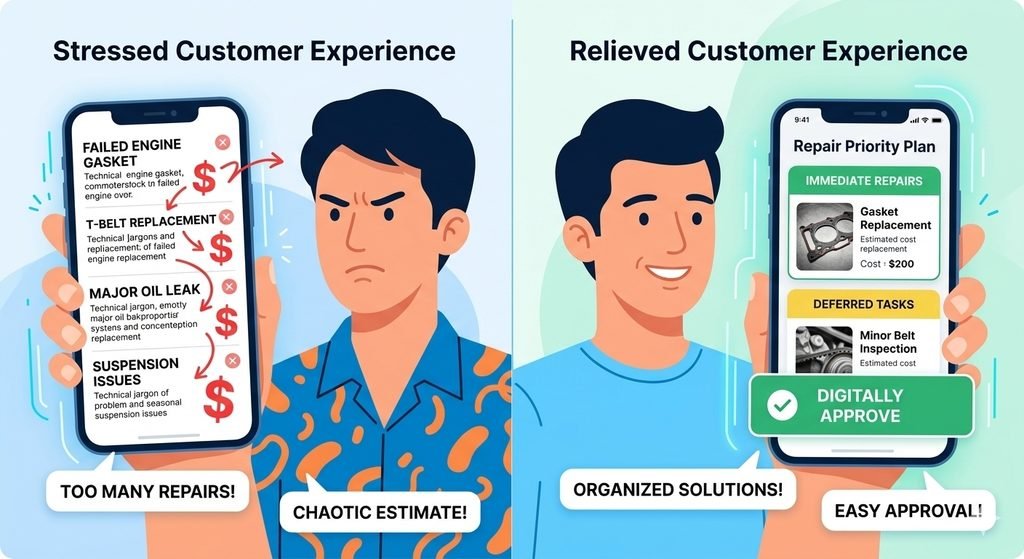
A declined estimate isn’t always a permanent no. Sometimes the customer needs more information, time, or an alternative way to manage the cost.
1. Price Shock
The final estimate may be higher than expected.
Explain what’s included, why the work is recommended, and what should be prioritized.
2. The Repair Isn’t Clear
Technical language can create confusion.
Advisors should explain the problem in plain language and connect the recommendation to the vehicle’s actual condition.
3. There Is Not Enough Evidence
Inspection photos, videos, and clear notes can help customers understand what they’re being asked to approve.
Evidence doesn’t guarantee repair approval, but it can reduce uncertainty.
4. The Customer Has a Budget Limit
A customer may agree that a repair is necessary but not be ready to approve the entire estimate.
Prioritization and appropriate financing options can help where available.
5. The Customer Doesn’t Trust the Recommendation
Trust influences customer buy-in.
Clear explanations, transparent pricing, consistent communication, and relevant inspection evidence can make the decision easier.
6. Too Many Repairs Are Listed Together
A long list can overwhelm customers.
Where technically appropriate, separate recommendations into immediate, upcoming, and monitor categories.
7. Nobody Follows Up
This is one of the simplest revenue leaks to overlook.
The estimate gets declined, the shop gets busy, and the opportunity disappears.
That’s why a structured declined estimate follow-up process matters.
The Second Voice Recovery Method
Second voice recovery gives the customer another informed conversation after an estimate remains pending or is declined.
The goal isn’t pressure. It’s another opportunity to answer questions and clarify options.
Manager Callback Protocol
A manager can:
- Review the estimate.
- Check advisor notes.
- Identify the likely concern.
- Contact the customer.
- Ask whether they have questions.
- Clarify the recommendation.
- Discuss appropriate options.
- Record the outcome.
This turns follow-up into a repeatable process.
Timing: 24-48-72 Hours
A practical sequence can be:
24 hours: First follow-up while the estimate is still fresh.
48 hours: Address unanswered questions.
72 hours: Make another appropriate contact or move the customer into longer-term follow-up.
Timing should reflect repair urgency and customer preferences.
Financing Presentation
If cost is the barrier, financing may give eligible customers another way to manage the repair.
Present it as an option rather than using it to push unnecessary work.
Coupon Campaign via SMS
For suitable customers, an SMS offer can reopen a price-sensitive conversation.
Clearly explain:
- Offer
- Eligibility
- Expiration
- Restrictions
Avoid sending irrelevant promotions to everyone.
Digital Approval Workflows
Paper-based processes can create unnecessary friction.
A digital workflow can look like:
Estimate Created → Estimate Sent → Customer Reviews → Customer Authorizes → CRM Updated → Repair Scheduled.
The objective is simple: make the next action obvious.
Digital estimates can also include inspection photos, videos, notes, itemized recommendations, and approval options.
When the approval status feeds back into the CRM, advisors can see which estimates are approved, declined, or still pending.
Authorization Rate Benchmarks
Be careful with universal benchmarks.
There isn’t one authorization percentage that applies equally to every repair shop. Results can vary by vehicle, repair type, estimate value, customer base, location, and advisor process.
Instead, build your own baseline.
Compare:
- Month over month
- Advisor to advisor
- Repair category
- Estimate value
- New versus returning customers
- Approved versus declined work
This gives your shop authorization KPI more context than an unexplained industry average.
Case Study: Turning More Estimates Into Approved Work
Consider this hypothetical example.
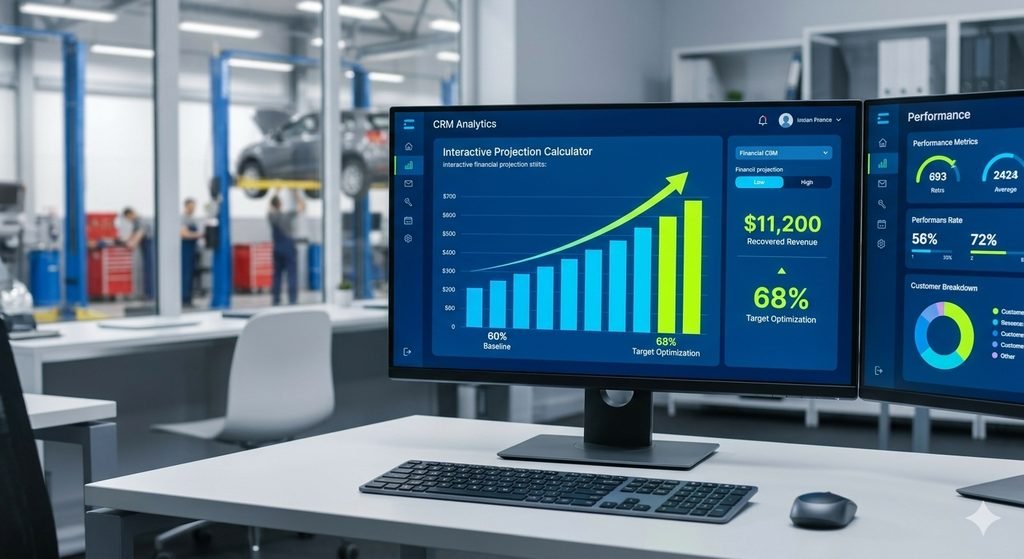
A shop receives 200 eligible estimates each month with a 60% authorization rate.
That means:
200 × 60% = 120 approved estimates
Now imagine the shop improves its process and reaches 68%.
200 × 68% = 136 approved estimates
That’s 16 additional approved estimates.
If the average approved repair is $700:
16 × $700 = $11,200
This is not a guaranteed result. Actual revenue depends on estimate values, repair mix, customer decisions, capacity, and other factors.
The point is simple: a modest improvement in approval rate can create a meaningful difference at scale.
Interactive Calculator: Authorization Rate Revenue Impact
Add a calculator to the live article using four inputs:
- Monthly eligible estimates
- Current authorization rate
- Target authorization rate
- Average approved estimate value
The calculator can show:
Current approved estimates
Additional potential approvals
Estimated revenue opportunity
Change in authorization rate
This gives shop owners a practical way to understand their own numbers rather than relying on generic examples.
How to Build an Authorization Rate Improvement Plan
You don’t need to change everything at once.
Week 1: Establish Your Baseline
Measure approved, declined, pending, and partially approved estimates.
Week 2: Improve Estimate Presentation
Coach advisors to:
- Explain repairs clearly
- Use relevant evidence
- Prioritize recommendations
- Answer questions
- Reduce unnecessary technical language
Week 3: Launch Declined Estimate Follow-Up
Build a consistent process using manager callbacks, SMS, and CRM automation.
Follow-up should be part of the workflow, not something someone remembers when the shop slows down.
Week 4: Measure and Optimize
Review:
- Authorization rate
- Quote conversion
- Recovered estimates
- Average approved estimate
- Revenue per repair order
- Advisor performance
Then focus on the weakest stage.
How AI Call Intelligence Supports Authorization Recovery
Your CRM may show that a customer declined an estimate. The conversation may explain why.
Kenix says its AI Analysis system analyzes advisor calls, flags potentially missed revenue, and turns conversations into coaching insights.
For authorization optimization, managers can look for patterns such as:
- Repeated price objections
- Unclear repair explanations
- Financing questions
- Missed follow-up commitments
- Customer uncertainty
The value isn’t simply recording calls. It’s turning conversations into actionable coaching.
Authorization Rate and the Revenue Recovery Framework
Authorization is one part of a larger customer journey.
Think of the chain:
Missed Call → Lost Lead → Missed Appointment → Unapproved Estimate → Lost Revenue.
Kenix describes five recovery areas across its platform: Call Recovery, Booking Recovery, Appointment Recovery, Approval Recovery, and Review Recovery.
That creates a natural revenue recovery framework.
Instead of always trying to generate more leads, a shop can first examine where existing customer opportunities are disappearing.
A Simple 30-Day Action Checklist
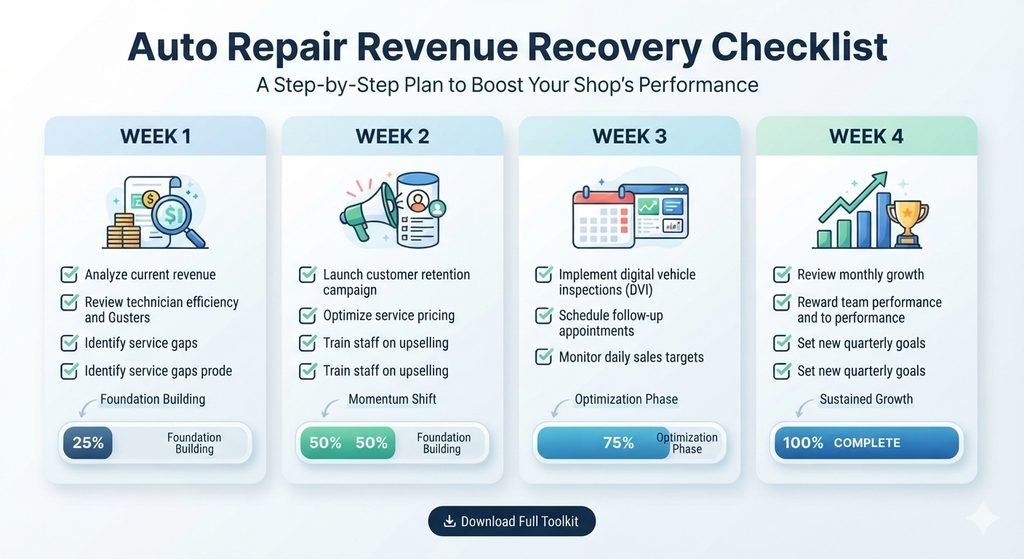
Week 1
- Calculate your current authorization rate.
- Define eligible estimates.
- Identify your highest-value declined estimates.
Week 2
- Review how advisors present estimates.
- Add better evidence.
- Simplify customer explanations.
Week 3
- Create a second voice recovery workflow.
- Set up declined-estimate follow-up.
- Introduce appropriate digital approval options.
Week 4
- Review authorization trends.
- Measure recovered revenue.
- Coach advisors using conversation insights.
- Adjust the process based on actual data.
Lead Magnet: Free Authorization Rate Worksheet
Turn this article into a lead-generation opportunity with a downloadable:
Auto Repair Authorization Rate & Revenue Recovery Worksheet
Include:
- Authorization rate calculator
- Declined estimate tracker
- 24-48-72 follow-up checklist
- Advisor KPI tracker
- Monthly revenue opportunity calculator
A CTA can appear after the calculator and again near the conclusion.
For the exit-intent offer, keep it closely related to the article:
Not ready to talk? Download the free Auto Repair Authorization Rate Worksheet and calculate your current approval opportunity.
That is more relevant than a generic newsletter popup.
Conclusion
Improving authorization rate auto repair performance isn’t about pushing customers to spend more.
It’s about making legitimate repair recommendations easier to understand, easier to evaluate, and easier to authorize.
Start with the numbers, identify why estimates are being declined, improve advisor communication, add useful evidence, simplify work authorization, and follow up consistently.
Then use CRM automation and AI call intelligence to identify patterns and improve the process.
Connect authorization rate to auto repair estimate conversion, ARO impact, quote conversion, and revenue per repair order.
That is when an overlooked KPI becomes a practical revenue recovery tool
Better communication creates better decisions. Better follow-up helps recover opportunities that might otherwise disappear.
Frequently Asked Questions
What is a good authorization rate for an auto repair shop?
There isn’t one universal target. Establish your own baseline and compare it by repair type, estimate value, advisor, and customer segment.
How do you calculate authorization rate in auto repair?
Divide approved eligible estimates by total eligible estimates and multiply by 100. Approved estimates ÷ eligible estimates × 100 = authorization rate.
How can I increase estimated approvals?
Answer rate improves with more detailed explanations, relevant inspection copies, and simplifying the approval process.
Why do customers decline auto repair estimates?
Some of the reasons may include lack of trust, inadequate explanation/evidence, too many recommendations, high repair costs, and no follow-up.
How should shops follow up on declined estimates?
Review the original estimate, understand the customer’s concern, contact them at an appropriate time, answer their questions, and record the outcome in your CRM.
Back to the previous article